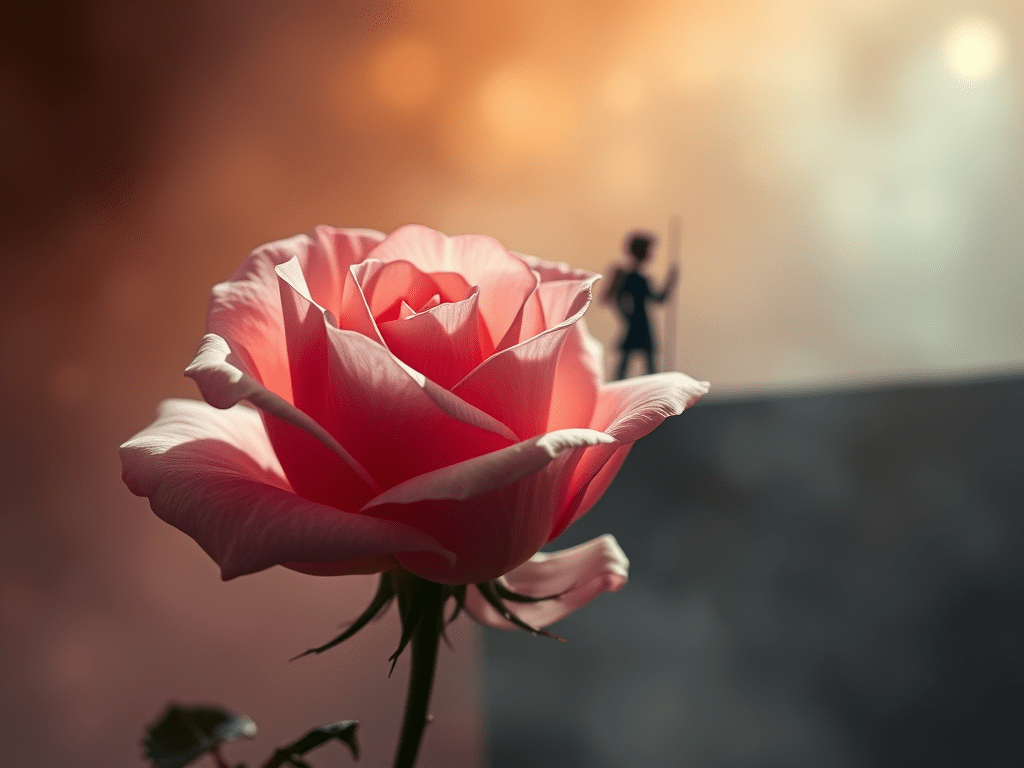

“The Rose and the Thorns” – about love and having the guts to listen.
It started with a sprout.
The Little Prince saw it one morning while taking care of his world. A different seed had started to grow. Like everything else unexpected in life, it filled him with wonder. It also made him worry.
He paid close attention.

Things that grow aren’t always safe. He was very aware of this. Baobabs also start out as simple green shoots. They can grow into monsters that crack the earth under their feet if nothing is done to stop them.
So, the Little Prince waited, not sure what to do. He hoped this new life would be a flower, but he was afraid it might really be another baobab.
He wasn’t aware of it yet. He was learning the first love truth. At first, love may come as a surprise. It is full of both hope and danger. It could look like beauty or danger. It looks like both a lot of the time.
When It Blooms

The flower finally got bigger and opened. He could not breathe after seeing what he saw. He had never seen anyone like her before.
A Rose—beautiful, flowing, and uniquely her own. The Little Prince fell deeply and without any doubt in love with her right away.
But he was confused almost right away.
The Rose wasn’t easy. She was haughty, picky, and easily hurt. That’s how she talked. She asked for strange things. She sighed deeply and gave him hints that he didn’t get.
She said there were drafts, but she turned down the glass dome. She wanted to be admired, but she didn’t care. She was pretty and far away, dainty and full of thorns.
The Little Prince said, “The flower is very complicated.”
That’s how he felt: amazed and worn out.
It wasn’t easy for him to love her.
Why the Thorns Were There
The Rose was proud of her thorns. They were her security, she said. They would keep her safe from tigers and other bad things. The Little Prince was confused and didn’t know what to think about this. He thought that her thorns were more of a sign than a tool. Still, she held on to them as if she were nothing without them.
“What good are thorns?” he had asked earlier, in pain.
The Rose wasn’t really trying to scare everyone, though.
Her goal was to keep herself safe.
The thorns were also not tools.
They were walls. How many of us do the same thing?
• Use humor instead of being honest how often do we?
• Pull away from each other when we want to be close?
• Pretend we don’t care because we feel open when we do?
The Rose was scared, but not of the Little Prince. She was scared of how much she needed him. Also, this is a love truth: When people want to connect with others the most, they often guard themselves the most. People often guard themselves most when they desire connection.

Not understood
The Little Prince didn’t get her. He had an open heart, was honest, and wasn’t complex. He was very clear when he loved. He couldn’t hide the fact that he was hurt.
As for how the Rose made her feel, she used a different language. She was complicated and unknown. She hid her need as pride. She covered up her fear with pride. The Little Prince began to wonder if she really cared because she didn’t say “I love you” clearly.
So, he started to pull away, which is something many people do when love gets complicated. His heart, which used to be happy, became heavy with worries.
He said, “One shouldn’t listen to flowers.” “It’s enough just to smell them and look at them.”
He didn’t want to listen anymore because it hurt too much. But this wasn’t knowledge; it was disappointment. That voice belonged to someone who loved deeply but hadn’t learned how to stay when things got tough yet.
We’ve all done this, right?
We fall in love with someone because they are beautiful. But we freeze when we see how complicated their feelings are.
We think that their emotional shields mean they are being rejected. “Maybe I should just admire them from afar,” we tell ourselves. Love is not admiring beauty from afar, though. It is wanting without being linked.
It asks us to listen, even if the words are hard to understand. This is what real, deep love. It tells us to stay, even if the other person hides behind their thorns. It asks us to believe, even if people are scared and hard to reach.
Things He Didn’t Know
In a later part of the story, the Little Prince will realize how wrong he was at this point. “I should have judged her by what she did.” I didn’t know how to love her yet. I was too young.
It’s too late for him to grasp that the Rose had truly loved him all along. However, it was not in the way he believed she would. Care, not judgment, was what she needed. Someone who could see past the thorns to the delicate flower inside was what she needed.
He left his world not because he stopped loving her. He didn’t get that love often speaks in strange ways. We need to learn how to understand it.
What This Tells Us
One of the most emotionally complex parts of The Little Prince is this chapter.
It also shows us a lot about how our own relationships work. Love starts with awe and grows through understanding. People who are hard to love are often the ones who worry that they are not loveable. Emotional complexity is not a flaw; it comes from pain, past experiences, and longing. Listening is more than just hearing words; it means figuring out what someone is trying to say emotionally.
Thoughts:
Think about the Roses in your life.
• Have you misunderstood someone because they didn’t show love the way you thought they would?
• Have you ever left a friendship or connection that was hard for you emotionally?
• Have you ever hid your need to be loved behind thorns like pride, snark, or distance?
If that’s the case, what would happen if you came back without answers but with kinder ears?
Love is not a problem that needs to be solved. It’s important to hold someone in their inconsistencies. Understand them in their doubts. Listen to them, not just admire them.
The Rose is hard to understand. We’re all the same.
To love someone, though, is not to escape the thorns.
To let the flower open, you have to stay for a while.


 Vita Dinamica: Dynamic Life