Tag: christianity

  • Reading together the book Acts of the Apostles: Daily Reflections for Easter-Pentecost 2025

    Easter 2025

    Welcome to the Journey!

    The Book of Acts narrates the events that occur after the resurrection. It tells what happens not just to Jesus’ followers, but to the world. Over the next 50 days, you’ll walk with the earliest Christians. They learn to live in the power of the risen Christ.

    This study is designed to help you:

    • Read Scripture deeply
    • Reflect personally
    • Engage in discussion
    • Grow in spiritual boldness, service, and love

    Each unit includes:

    • 📖 A short Scripture reading
    • 🔍 Reading comprehension questions
    • 🧠 Key vocabulary
    • 🗣️ Group discussion prompts
    • ✍️ A journaling question for personal reflection

    Whether you’re working through this on your own or with a group, this is more than just a workbook. It’s a training ground to live the resurrection every day. From the upper room to the ends of the earth, God is still writing the story—and you’re part of it.

    So grab a pen, a Bible, and an open heart.
    Let’s begin.

    📚 Table of Contents

    UnitTitleScripture
    1The Promise of the SpiritActs 1:1–5
    2The Ascension of JesusActs 1:6–11
    3Praying in the Upper RoomActs 1:12–14
    4A New Witness is ChosenActs 1:15–26
    5Pentecost – Filled with the SpiritActs 2:1–13
    6Peter’s Bold ProclamationActs 2:14–41
    7A Devoted Resurrection CommunityActs 2:42–47
    8Living the Resurrection TogetherReview: Acts 1–2
    9Healing at the Beautiful GateActs 3:1–10
    10Peter Speaks to the CrowdActs 3:11–26
    11Boldness in the Face of OppositionActs 4:1–22
    12The Church Prays for BoldnessActs 4:23–31
    13One Heart and SoulActs 4:32–37
    14Ananias and SapphiraActs 5:1–11
    15Signs, Wonders, and Unstoppable WitnessActs 5:12–42
    16Called to ServeActs 6:1–7
    17Stephen’s Bold WitnessActs 6:8–15
    18Stephen’s Final MessageActs 7:1–53
    19Stephen’s Death and Saul’s RoleActs 7:54–8:3
    20Scattered but Still SpeakingActs 8:4–25
    21Philip and the Ethiopian OfficialActs 8:26–40
    22Saul Encounters the Risen ChristActs 9:1–19
    23Saul Begins to PreachActs 9:20–31
    24Aeneas is HealedActs 9:32–35
    25Tabitha is Raised to LifeActs 9:36–43
    26When God Redefines the BoundariesActs 10:1–33
    27Resurrection Life in a New CityActs 11:1–18
    28When the Church Suffers—and PraysActs 12:1–19
    29When Power Falls and the Word RisesActs 12:20–25
    30Sent by the SpiritActs 13:1–12
    31The Promise FulfilledActs 13:13–52
    32Persevering with Resurrection BoldnessActs 14:1–7
    33Redirecting the GloryActs 14:8–20
    34Strengthening the Souls of the DisciplesActs 14:21–28
    35Grace Is EnoughActs 15:1–21
    36The Joy of Grace Made ClearActs 15:22–35
    37When Resurrection People DisagreeActs 15:36–41
    38Guided and Connected by the SpiritActs 16:1–5
    39When God Redirects the JourneyActs 16:6–10
    40Open Hearts and a Riverside RevivalActs 16:11–15
    41Singing in the DarkActs 16:16–40
    42Revival and Resistance in ThessalonicaActs 17:1–15
    43Known by the Unknown GodActs 17:16–34
    44“Do Not Be Afraid—I Am With You”Acts 18:1–17
    45Strengthening What God Has StartedActs 18:18–23
    46Teachability Is Resurrection StrengthActs 18:24–28
    47When the Word Takes RootActs 19:1–20
    48A Life Poured OutActs 20:17–38
    49Resurrection at the Heart of the StormActs 21–28
    50You Are the Next ChapterReflection & Prayer
  • The Gospel of Mark 09

    The Gospel of Mark 09

    Withdrawing to Pray, Moving to Preach

    — A Reflection on Mark 1:35–39

    After a full night of healing the sick and casting out demons, Jesus does something unexpected. While the town still sleeps, before the sun even rises, He quietly leaves the house of Simon and Andrew. The crowds are growing, His name is spreading, and the demand for His presence is intensifying.

    And yet, Jesus withdraws.

    “And rising very early in the morning, while it was still dark, he departed and went out to a desolate place, and there he prayed.” (Mark 1:35)

    The Solitude of Jesus

    Mark’s Gospel is known for its urgency. Everything happens “immediately,” everything moves fast. Yet here, Mark pauses. And in that stillness, we catch a rare glimpse of Jesus’ inner rhythm: He steps away from the crowds, the miracles, and the demands—and He prays.

    It’s early. It’s dark. The healings of the night before still hang in the air. But Jesus chooses not to remain where others expect Him. He chooses stillness. He chooses communion with the Father.

    Jesus was fully divine—but also fully human. And as a human, He needed solitude. He needed stillness. He needed time alone with God.

    In our world, where productivity is often mistaken for purpose, Jesus offers a radically different example: He stops. And He shows us that prayer isn’t a break from mission—it is its very foundation.

    His strength didn’t come from applause or activity.
    It came from alignment with the Father.

    Urgency vs. Clarity

    Meanwhile, the disciples wake up to find Jesus gone. They search frantically, and when they find Him, they say:

    “Everyone is looking for you.” (Mark 1:37)

    They speak with urgency. They feel pressure. There’s more healing to do, more people to see. But Jesus doesn’t rush back. He doesn’t return to yesterday’s miracles. Instead, He replies:

    “Let us go on to the next towns, that I may preach there also, for that is why I came out.” (Mark 1:38)

    He doesn’t stay where He is admired. He moves forward—because His mission isn’t comfort or popularity—it’s proclamation.

    This moment is full of clarity. If Jesus had stayed where He was successful, He would not have fulfilled His deeper purpose.

    Prayer didn’t slow Him down. It clarified His calling.

    Not Every Need Is Your Calling

    This brief passage invites us into a larger truth: not every good opportunity is your assignment.

    Yes, there were still sick people in Capernaum. But Jesus knew His purpose was bigger than one town’s expectations. He wasn’t guided by pressure—He was rooted in purpose.

    Can we say the same?

    Too often, we’re shaped by the needs around us, the opinions of others, the urgency of everything and everyone. But if we don’t step away and listen, we risk living from noise instead of from truth.

    Jesus’ time alone with the Father shows us:

    • Prayer brings clarity.
    • The urgent isn’t always the important.
    • Saying yes to God often requires saying no to others.

    What This Means for Us

    This passage isn’t just about Jesus—it’s about us.

    How often do we confuse movement with meaning? How often do we let ourselves be pulled by expectations instead of led by calling?

    Jesus offers another way:

    • Step away. Even when demands are high.
    • Listen deeply. Let prayer show you the deeper purpose.
    • Move forward, not where you’re most comfortable, but where you’re most called.

    He wasn’t led by public demand. He was led by the voice of the Father.

    And that made all the difference.

    The Invitation Still Stands

    Maybe you’re feeling stretched thin today. Maybe expectations press in from every direction. Maybe you’re successful in what you’re doing—but you wonder if it’s what you’re truly called to.

    Jesus invites you to stop.

    To pray.

    To listen.

    And then—to move forward, not from pressure, but from purpose.

    The most important moments don’t come from busyness, but from stillness.
    The truest calling doesn’t rise from applause, but from presence.
    And real progress may require leaving behind what’s working—so you can follow what’s true.

    The invitation still stands.
    Will you make space to hear it?

  • 06 Mark 1:16-20 The Call To Follow

    Jesus does not build His kingdom alone.

    From the very beginning of His ministry, He calls others to walk with Him, to learn from Him, to become part of something greater than themselves. His mission is not just about proclaiming truth—it is about forming a community, a people who will embody His message long after He is gone.

    Mark tells us the story simply:

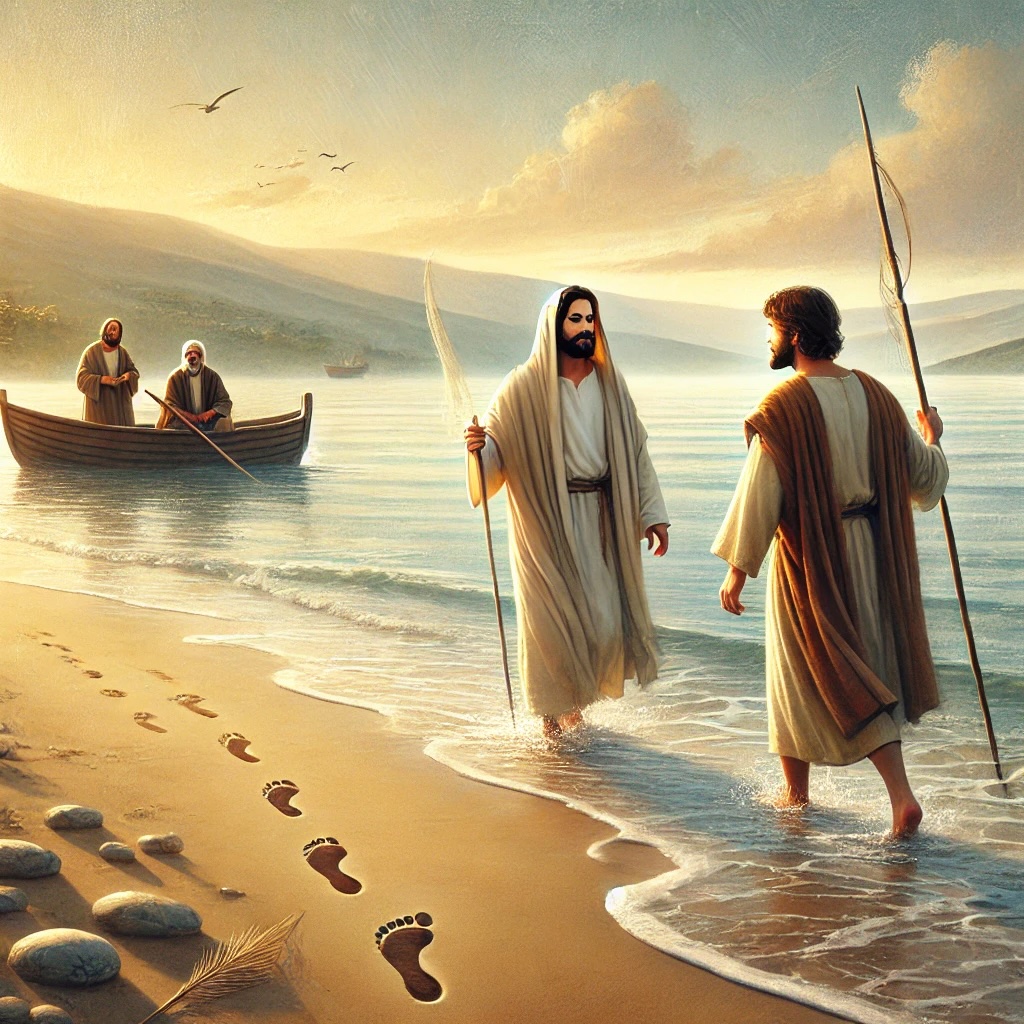
    “Passing alongside the Sea of Galilee, he saw Simon and Andrew, the brother of Simon, casting a net into the sea, for they were fishermen. And Jesus said to them, ‘Follow me, and I will make you fishers of men.’ And immediately they left their nets and followed him. And going on a little farther, he saw James the son of Zebedee and John his brother, who were in their boat mending the nets. And immediately he called them, and they left their father Zebedee in the boat with the hired servants and followed him.”

    There is something disruptive about this moment. These men are not idle. They are not searching for a teacher. They are fishermen, doing what they have always done, tending to the daily work of survival. And yet, when Jesus calls, they drop everything.

    A Call That Interrupts

    Jesus does not wait for Simon, Andrew, James, and John to come to Him. He goes to them. He meets them in their ordinary lives, in the midst of their routines. They are casting nets, mending gear, preparing for another day of work—until Jesus steps in and everything changes.

    We often imagine that life-changing moments come with preparation, with time to consider, with warning signs leading up to them. But in Mark’s Gospel, the call of Jesus is sudden, urgent, and immediate. There is no space for hesitation.

    And yet, there is something about Jesus that compels them to follow. He offers no roadmap, no security, no certainty about what will come next. All He says is, “Follow me.” And they go.

    Perhaps that is how real transformation works. It comes not when we are ready, but when we are willing. It does not always come with full understanding, but with an openness to step forward even when we do not know what the future holds.

    Leaving Behind the Nets

    What Simon, Andrew, James, and John do next is astonishing.

    “Immediately they left their nets and followed him.”

    Their nets were not just tools; they represented security, identity, livelihood. To leave them behind was to step into the unknown, to release the only life they had ever known.

    James and John leave behind not just nets, but their father. Their departure is not just a career shift; it is a radical severing of ties, a complete reordering of priorities.

    Jesus’ call is not a casual invitation—it demands a response that costs something. To follow Jesus means to let go, to release what is comfortable, to step away from what is familiar.

    And yet, they do not hesitate. Why? Because what Jesus offers is greater than what they leave behind.

    Fishers of Men: A New Purpose

    Jesus does not just tell them to follow Him—He redefines their identity.

    “Follow me, and I will make you fishers of men.”

    He does not say, Follow me, and you will be my students. He does not say, Follow me, and you will find deeper spiritual peace. Instead, He speaks in their language, through their experience.

    They were fishermen. This was what they knew—casting nets, waiting, gathering the catch. And now, Jesus takes that same skill, that same patience, that same endurance, and transforms it into something eternal.

    “I will make you fishers of men.”

    Their skills are not erased; they are redeemed for a greater purpose. They will still cast nets, but now for hearts and souls. They will still wait, but now with the patience of those who bring good news. They will still gather, but now into a kingdom that will never fade.

    God does not call us to abandon who we are—He transforms what we already know into something new. The gifts, talents, and experiences we have do not disappear when we follow Jesus. They are redirected, reshaped, repurposed for something greater than we ever imagined.

    The Cost of Following

    It is tempting to read this passage and admire the disciples’ immediate response without considering what it cost them.

    Simon, Andrew, James, and John did not just leave behind nets—they left behind their old way of defining themselves. Their work, their families, their sense of place in the world—all of it changed the moment they said yes.

    Following Jesus is never about adding Him to an already full life. It is about redefining life around Him.

    And yet, even in the leaving, there is gain.

    What they lost in security, they gained in purpose.
    What they gave up in familiarity, they received in calling.
    What they left behind in certainty, they stepped into in faith.

    Jesus does not call people to comfort. He calls them to Himself. And that is always worth whatever we must leave behind.

    The Call Today: Will You Follow?

    This story is not just about Simon, Andrew, James, and John. It is about every one of us.

    Jesus is still walking along the shores of our lives, still stepping into our ordinary routines, still speaking those two simple words:

    “Follow me.”

    The question is, will we?

    What nets are we holding onto that keep us from stepping forward? What security are we afraid to leave behind? What is Jesus calling us to step into, even when we feel unprepared?

    Following Jesus is not about having all the answers. It is about taking the first step.

    And like those first disciples, when we leave behind our old lives, we are stepping into something far greater than we ever imagined.

    The call has not changed.

    The invitation is still open.

    Will you follow?


    Leave a comment

  • Living the Present Moment … in time of Political and Social Stress

    Present, Not Panicked!

    For us Christians, one of the paths to encountering and loving God is through the present moment. The term “mindfulness” refers to a practice that enables us to grow in awareness of this very moment. Mindfulness helps us become fully conscious of the Present Moment, which is exactly where we meet God.

    Imagine the Stoic Emperor Marcus Aurelius writing in his personal reflections two thousand years ago, unaware that you would one day read his words. In his profound work “Meditations,” he captured an insight by quoting Plato:

    How beautifully Plato put it. Whenever you want to talk about people, it’s best to take a bird’s-eye view and see everything all at once—gatherings, armies, farms, weddings and divorces, births and deaths, noisy courtrooms or silent spaces, every foreign people, holidays, memorials, markets—all blended together and arranged in a pairing of opposites.” – (Meditations, 7.48)

    Today, we live in a world more interconnected and tumultuous than ever, constantly inundated with news and opinions, often starkly divided and presented as opposites. Social media, news feeds, and even our phones offer an endless stream of information, distractions, and emotional triggers. Like Marcus Aurelius suggested, we must rise above it all in our minds, seeing the vast array of human experiences without becoming emotionally ensnared by them.

    As followers of Christ, how do we navigate this complex landscape without succumbing to anxiety, anger, or despair? How do we stay informed yet remain grounded in peace? The key lies in mindfulness—a practice that harmonizes beautifully with Christian spirituality.

    Mindfulness: Observing Without Judgment, Releasing with Trust

    Mindfulness is about being fully present in the moment, calmly observing thoughts, emotions, and external events without judgment, allowing us to gently release anxiety and attachment. Rather than quickly labeling political news or events as “good” or “bad,” mindfulness invites us to observe with calm discernment and entrust everything to God’s sovereign plan.

    Jesus himself embodied this mindful approach when He said in Matthew 6:34, “Do not worry about tomorrow, for tomorrow will worry about itself.” His invitation was not toward passivity or ignorance but toward spiritual awareness that liberates us from worry. Jesus calls us to place our ultimate security not in human institutions or political outcomes but in God’s unchanging love.

    The Emotional Weight of Political Anxiety

    Political stress is a genuine concern for many people today. Constant exposure to negative or divisive news can trigger chronic stress responses, leading to anxiety, frustration, and hopelessness. From a Christian perspective, such emotional strain hinders our ability to embody Christ’s peace and love effectively. Instead of trusting in God’s ultimate sovereignty, we can find ourselves overly reliant on human efforts, causing our faith to waver.

    Embracing Mindfulness in Times of Political Unrest

    By incorporating mindfulness into our political and social awareness, we remain present without being swept away by negative emotions. Here’s how you can apply it:

    1. Observe Before Reacting

    Mindfulness trains us to pause before responding. When distressing news arises, take a breath, observe without judgment, acknowledge your emotions, and then respond with thoughtful prayer rather than immediate reaction.

    2. Mindful Media Engagement

    One major contributor to political anxiety is relentless media consumption. Practice mindfulness by:

    • Setting clear boundaries around news intake.
    • Selecting trustworthy, balanced sources.
    • Taking regular breaks from screens to reflect and pray.

    3. Ground Yourself in Prayer and Scripture

    In turbulent times, Scripture reassures us of God’s steadfast presence. Merge mindfulness with Christian practice by reflecting on verses like:

    • John 14:27“Peace I leave with you; my peace I give you…”
    • Philippians 4:6-7“Do not be anxious about anything…”

    Meditate on these words to foster internal peace amidst external turmoil.

    4. Engage Compassionately

    Mindfulness reminds us to see beyond politics and recognize the humanity in others. Engage in political conversations with compassion, patience, and empathy, embodying Christ’s commandment to love our neighbors—especially those we disagree with.

    5. Surrender What You Cannot Control

    Feelings of powerlessness often accompany political anxiety. Mindfulness teaches us to discern our responsibilities and let go of what lies beyond our influence, entrusting it to God.

    Practice a simple breath prayer:

    • Inhale: “Lord, I trust You.”
    • Exhale: “I release my worries to You.”

    This act of letting go is not resignation but active faith.

    Conclusion: Embracing Peace Amidst Chaos

    As Christians, we are called to be a calming, constructive presence in the world. Mindfulness does not call us to ignore reality but empowers us to engage it from a place of trust and peace. Inspired by the wisdom of Marcus Aurelius, take that bird’s-eye view—recognize the world’s complexity without becoming emotionally entangled.

    You have already chosen a path that will endure all of life’s fluctuations—weddings and divorces, births and deaths, turmoil and tranquility. The world is indeed busy and demanding, constantly pulling at your attention.

    Yet, you matter immensely, now and always. The world’s turbulence underscores the importance of embracing this moment. Waiting for a “better time” is an illusion.

    We never shall have any more time. We have, and we have always had, all the time there is.”

    So, breathe. Observe. Pray. Let your faith guide you, knowing that in God’s kingdom, peace reigns supreme.


    Leave a comment

  • 02. Prepare the way (Mark 1:2-4)

    It is not comfortable to be in the wilderness. It is empty, crude, and fraught with doubt. John the Baptist, however, emerges in the desert and cries forth a message that has endured throughout history: Prepare the way of the Lord. His voice does not emanate from the center of religious authority or the corridors of power. Rather, he invites individuals to enter a moment of transformation by standing where few would dare to live.

    John makes it clear that repentance and renewal are necessary. He makes no promises of immediate reform or an easy path forward. Instead, John exhorts people to plunge into the waters of baptism. He urges them to immerse themselves in the Jordan. They should let go of things that no longer serve them. His baptism is a symbolic act of readiness. It is a prelude to something bigger, which they do not yet completely comprehend. It is not merely a physical act of cleaning.

    According to the Gospel of Mark, John wore camel’s hair, a garment that is symbolic of the prophet Elijah, who was to arrive before the Lord’s great and awful day. His existence marks a watershed in history. Something new is emerging as the old fades. But letting go is necessary before embracing the new. People travel to him for this reason from all around Jerusalem and Judea. The wilderness, the discomfort of introspection, and the prospect of rejuvenation all appeal to them.


    John doesn’t talk about himself. One who is stronger than I, whose sandals’ strap I am not worthy of untying, follows me. He is aware that his position is only transitory and that his job is to make room for someone else. He is remarkably humble. John is happy to remain in the background during a period when religious leaders were vying for attention and authority, pointing to the one who will be baptized with the Holy Spirit rather than water.

    The necessity of preparing for change before it can truly take hold is a common theme in this passage. No change occurs in a vacuum. We must face our past and look to the future, just as the people in John’s day did. Without having to put forth the effort to create space for it, it is simple to yearn for something new. We wish for rejuvenation but oppose the purification. We desire a new beginning, but not the wilderness that frequently accompanies it.

    Μετάνοια (metanoia), the Greek term for repentance, is more than just feeling sad for past transgressions. It signifies a reorientation of one’s entire being, a complete shift of mind and heart. This is an active turning, a conscious decision to take a different course, rather than merely an emotional reaction. Repentance is realigning—realizing what is broken and allowing it to be fixed—rather than wallowing in guilt.

    Therefore, the wilderness is more than just a location on a map. It is a soul-related condition. It is where we go when we are lost, when life deprives us of our illusions, and when we have to face the truth. It is in the unnerving grandeur of the unknown, rather than the comfort of the known, that transformation starts. Nevertheless, Mark informs us that the people voluntarily support John. They look for him because they must, not because the wilderness is simple.

    Maybe this is where we are right now, on the brink of something new, knowing that something has to change but not knowing how to start. We can still hear John’s voice saying, “Set the path.” However, how do we get ready? How can repentance manifest itself in our daily lives?

    The necessity of letting go


    For some, it might be about letting go of burdens that have been held for too long. These include regrets, past injuries, or lingering anxieties. For others, it can entail identifying the habits that have prevented them from moving forward. They need to realize what needs to be addressed. Openness, not perfection, is the hallmark of true preparation. It’s about creating room for the future, even if we don’t fully comprehend it yet.

    Repentance is a reorientation of one’s entire being, a complete shift of mind and heart


    John informs the people that Jesus is close by, but they must purify their hearts before they can accept him. This is an internal metamorphosis rather than an outward ceremony. The impending one will immerse people in God’s own presence by baptizing them with the Holy Spirit. However, we must first leave the old in order to immerse ourselves in the new. We are unable to hold onto both simultaneously.

    John would probably say the same thing if he spoke to us now. They would interrupt the din of everyday existence, urging us to stop, look around, and become ready. He would tell us that we must accept what we are leaving behind before we can fully welcome what lies ahead. He would welcome us into the woods as a place of enlightenment and rejuvenation rather than as a place of punishment.

    The outdoors is sacred yet uncomfortable. Distractions disappear there, all that is untrue is eliminated, and the reality of who we are and who we are becoming becomes apparent. In order to be ready to accept the greater when he arrives, we must first prepare our hearts and straighten the road.

    Thus, the question still stands: What needs to be resolved in your life before you may proceed? What needs to be let go, admitted, or given up for regeneration to begin? Just like in John’s day, the invitation is now available. The call is still the same. Clear the path.

    Are you going to advance?


  • Mark 1:1

    1.1  “The Beginning of the Good News of Jesus Christ, the Son of God”

    A Reflection

    Mark 1:1 proclaims: “The beginning of the Good News of Jesus Christ, the Son of God.” Each word in this verse carries profound theological and philosophical significance, shaping not only the Gospel’s narrative but also the very foundation of Christian faith. This single sentence is an invitation into a new beginning, an introduction to Good News, a revelation of Jesus Christ, and a declaration of His divine identity as the Son of God. To understand it fully, we must explore how these elements interconnect into a single, transformative reality.

    1. The Beginning: The Moment of Creation and Renewal

    A beginning is never just a starting point—it is the birthplace of transformation. Just as Genesis 1:1 describes the creation of the universe, Mark 1:1 announces a new creation, a divine eruption into history. The Good News does not simply start with Jesus; He is the beginning—the arche, the source from which all things flow.

    Beginnings are moments of possibility and renewal, where something new emerges from nothingness. They introduce form where there was formlessness, structure where there was chaos, and meaning where there was emptiness. To say that the Gospel begins is to say that God is doing something new—not just in history, but in the lives of those who hear it. This is not just a story unfolding; it is an invitation to step into a transformed life.

    2. The Good News: More Than a Message, a Living Reality

    The Good News is not merely information; it is an event, a proclamation, a transformative encounter. News, by definition, changes reality—it alters perception, reshapes understanding, and demands a response. But what makes news good? It is not simply the fulfillment of human desire but a revelation of the ultimate truth, the ultimate good.

    The Good News of Jesus Christ is good not because it brings temporary relief, but because it reorders human existence, offering hope, salvation, and a new way of being. It is the resolution of humanity’s deepest uncertainty—the longing for meaning, for reconciliation with God, for eternal life.

    Yet, news can be unsettling. Just as good news for one person might be disruptive for another, the Gospel challenges old ways of living. It comforts the brokenhearted but unsettles those who cling to power, to pride, to self-sufficiency. The Good News invites us to let go of the old and embrace the new, but such an invitation requires courage, humility, and faith.

    The Good News of Jesus Christ is good not because it brings temporary relief, but because it reorders human existence

    3. Jesus Christ: The Center, Perimeter, and Radius of the Good News

    The Good News is not just about Jesus; it is by Jesus and belongs to Jesus. He is both the messenger and the message, the Word made flesh. To say that the Gospel is of Jesus Christ is to acknowledge that He is its center, its source, and its fulfillment.

    The name Jesus (Yeshua) means “God saves.” His very name declares His mission: to bring salvation. The title Christ (Messiah) affirms Him as the anointed one—the fulfillment of God’s promises, the long-awaited king who reigns not by force, but by sacrificial love.

    Everything in the Gospel is about Jesus, but more than that, everything is done by Him and through Him. He does not merely announce a new way of life; He is the way, the truth, and the life (John 14:6). Accepting the Good News is not just believing in a message—it is entering into a relationship with a Person, the one who embodies and owns the message itself.

    4. The Son of God: The Divine Identity of Jesus

    The title “Son of God” is the key to understanding who Jesus is and why His Good News matters. In ancient thought, to be a “son” meant to share in the essence, mission, and authority of the father. To call Jesus the Son of God is to declare that He is not just a prophet or a teacher, but that He shares in God’s very nature.

    Just as a son carries forward his father’s work, Jesus is the full revelation of the Father—His character, His love, His justice. He does not simply speak about God; He is God made visible.

    But His sonship is also a call to relationship. Jesus, the Son of God, opens the door for us to become children of God (John 1:12). He invites us to share in His sonship—to be adopted into the divine family, to enter into communion with God through Him.

    5. The Unified Meaning: An Invitation to Transformation

    Mark 1:1 is not just an introduction to a book—it is an invitation to step into a new life.

    • It is a beginning—a moment of renewal, where the old passes away and something new is born.
    • It is Good News—not just information, but transformation, a truth that changes everything.
    • It is of Jesus Christ—centered in Him, proclaimed by Him, and belonging to Him alone.
    • It is the proclamation of the Son of God—a revelation of who Jesus is and what He offers to those who accept Him.

    To embrace this verse fully is to embrace the reality it declares. It means recognizing that the story of Jesus is not just something to read, but something to live. It is an invitation to step into a new beginning, to be shaped by the Good News, to be drawn into the life of Jesus Christ, and to discover our own identity as children of God.

    The beginning has been announced. The Good News is proclaimed. Jesus Christ, the Son of God, stands before us.

    The only question is: How will we respond?

    1. What is a “beginning” in my life that changed me profoundly? How did it shape who I am today?
    2. How do I feel about the idea that every moment is an opportunity to begin again? Where in my life do I need a fresh start?
    3. What does Good News mean to me? What is the best news I have ever received, and how did it change my perspective?
    4. How does the Good News of Jesus differ from the “good news” the world offers?
    5. What does it mean to be a son or daughter of someone? How does this shape my understanding of Jesus as the Son of God?
    6. What is one practical step I can take this week to live out the reality of the Good News in my life?

  • Mark 1:1-13

    Mark 1:1-13

    The Power of New Beginning

    The first part of Mark’s Gospel is very urgent and strong, announcing a new beginning right away. Matthew and Luke both begin with Jesus’ family history and birth, but Mark goes straight to His work in public life. Mark’s opening, which is so clear and to the point, shows how Christian life works: it’s an active life, not an observational one; it’s a call to move, believe, and go into doubt. Mark’s beginning announces a new life that comes from moving, having faith, and facing uncertainty.

    It starts with “The beginning of the gospel of Jesus Christ, Son of God.” These words start a story, but they do it in a bigger and more meaningful way. They start a miracle story all over again. Mark’s use of “the beginning” forces us to see an event in a bigger context—not just another event in a schedule, but a fresh start for a change. When you start a new trip, you’re going into the unknown. You’re also starting a journey of growth, not a quick-fix accomplishment. Any moment in time offers a chance to start over, a chance to move forward in hope.

    People often get stuck and don’t do anything because they don’t want to move forward because of failures in the past or fear about the future. In Mark’s Gospel, it is taught that everything starts out in a messy, unsure, and sometimes rough way. But these kinds of starts have a lot of promise. Beginning is a faith-based act that means you are ready for change even though you can’t see the way ahead. You shouldn’t wait for everything to be right before taking the first step.

    Many people don’t start a new project because they don’t feel ready. They think they need to get everything right first. Mark’s Gospel, on the other hand, doesn’t start with perfection, but with action. Jesus doesn’t wait for the right time to do something; instead, he goes to work on purpose. Just the fact that it’s so important is a lesson. If we don’t start when we’re not ready, then maybe we won’t start at all. That’s a lesson in hope. That doesn’t mean being totally ready; it means having faith that God will meet us where we are when we’re ready to move forward.


    The word “the beginning” makes you think of movement. Faith is not a state of being still; it requires action. We must consciously move toward change if we want to grow spiritually, emotionally, and mentally. Having hope in something, no matter how small, can start a big change. You can make the first move at any time, because the present is a holy moment full of possibilities.

    Every morning is a fresh start. We can change our state of mind just by knowing that. To change our course, we can take a deep breath, pause, and remember that today is a fresh start, a chance to hold on to hope without fear. By looking at life as a trip that is still to be taken, we can figure out what motivates and holds us. Knowing that heart-led change is possible with every breath, we can let go of fear, doubt, and regret and replace them with hope and rebirth. New starts are a theme that runs through the Bible: Genesis begins with the words “In the beginning, God created…” This is how life came into the world from nothing. After the flood, Noah and his family landed on dry land, joining a world that had never been made before. The Israelites were freed from slavery during the Exodus. They were given a fresh start in a free land. The rising of Jesus made a fresh start, turning death into life. All of these things tell us that God is always making new things. We always have the chance to start a new life, no matter how bad things get.

    Mark’s Gospel isn’t just a story about what happened; it’s also a personal call to start over. Every new moment gives us a chance to start over, whether we’re starting a new job, going through a tough time, or just wanting a fresh start in life. Not by changing things in the outside world, but by going through a deep change on the inside, letting go of what holds us back and moving toward what God wants us to move toward.

    If you want to walk by faith, you have to take one step, even if you don’t know where you’re going. There is no such thing as overnight growth or instant change. It happens slowly and over time, even if you accept and take one step at a time. God met Noah after the flood, led the Israelites through the desert, and raised Jesus from the dead. Just like that, He meets us at the start of every new day, giving us grace, strength, and the knowledge that we are not alone.

    Trust is needed to start over. You have to be ready to let go of your need to know and believe in your faith in the not knowing. We need to let kindness fill in the gaps where we feel like we’re not good enough. It means seeing the present as holy and believing that God is at work, even if we can’t see the results yet. No matter what we go through or how hard things get, we always have the chance to start over. Mark 1:1 isn’t the beginning of the Gospel; it’s a call to change. It’s not a question of whether we’re ready; it’s a question of whether we’re willing. Long-term travelers all start with one step. Even though things will never be perfect, God’s kindness is always there, ready to help us take that first step. The offer is right in front of us.

    Will we take it and get ready for a fresh start?