Tag: bible

  • 11 Lowered to Grace

    11 Lowered to Grace

    The Courage to be seen.

    Mark 2:1–12

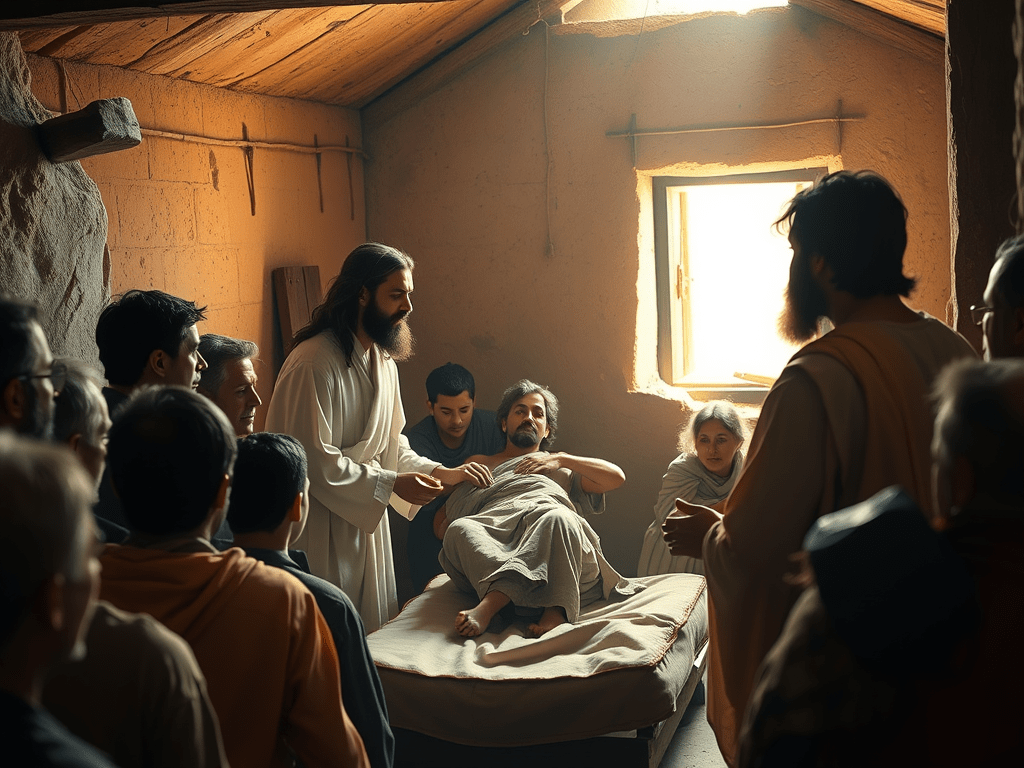
    One of the most quietly revolutionary episodes in all of Scripture is in the second chapter of Mark’s Gospel. There were no bright lights or loud voices from the skies. A small, crowded house in Capernaum, and the sound of a roof being ripped off.

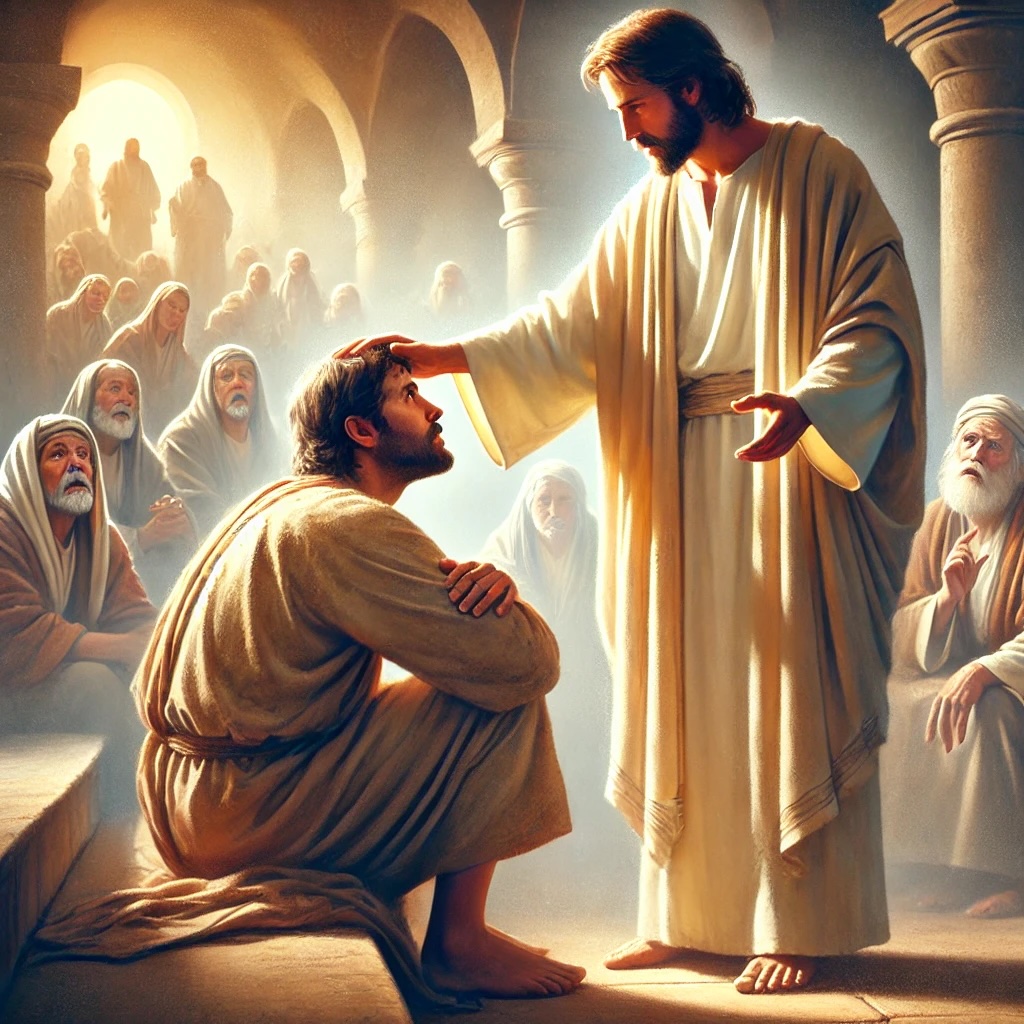
    Jesus is teaching down here. Four friends are lowering a disabled man into His presence above. The room goes quiet. Then Jesus speaks. It’s not a command to walk, but something much more personal and disarming:

    “Son, I forgive you for your sins.”
    —Mark 2:5

    What comes next is more than a miracle. It is an invitation to the kind of spiritual freedom that changes lives, not just for the man on the mat, but for all of us who know what it feels like to be stuck.

    When Movement Comes to a Halt

    We all have a mat. A spot where we’ve stopped moving. Fear is what some people feel. Some people feel guilt, tiredness, self-doubt, or a wound that has been hidden for too long. We often don’t get to Jesus on our own, but because of the gentle charity of those who help us through friendship, prayer, or just not letting us give up.

    “Sometimes the first step toward healing isn’t walking; it’s being willing to be carried.”

    In this case, the man who was crippled didn’t say anything. He didn’t say he was sorry. He didn’t say a prayer. He just let people see him. That was all it took.

    The Healing That Came Before the Miracle
    Jesus doesn’t talk about the man’s physical condition right away. Instead, He talks to his soul directly.

    “Son…”

    It’s more than simply a greeting; it’s a way to get your identity back. Jesus heals the self before he heals the body.
    He gives a sense of belonging before action.
    Before change, He offers acceptance.

    “To be known in your weakness and still be called beloved—that is the beginning of true healing.”

    We frequently think that being strong will help us be seen. But in this case, Jesus changes the story. Being completely open and honest is what draws His attention and opens the door to grace.

    The More Serious Conflict

    Of course, not everyone in the room was okay with this form of healing. The religious experts, or scribes, were shocked. They asked each other in silence, “Who can forgive sins but God?”

    They were right. But they weren’t ready for the answer either.

    Jesus, who knows their hearts, doesn’t argue with them; instead, He asks them a question:

    “Which is easier: to say, ‘Your sins are forgiven’ or to say, ‘Get up, take your mat, and walk’?”

    And then He urges the man to get up to show that He is in charge. And he does.

    He picks up the mat that once held him and walks away, complete, restored, and living.

    A Question for Us

    This chapter gives us a challenge that goes beyond religion and into the heart of personal change:

    Are we okay with being seen as we really are?

    Can we agree that grace comes before doing well?

    Are we ready to move into a life that is in line with the truth, both physically and spiritually?

    This is when being real and accepting others completely come together. Not the shallow type of self-acceptance that doesn’t want to change, but the profound kind that says, “I am not condemned, even here and now.” They are calling me.

    “Being real is what brings healing, not getting everything right.”

    A Way to Get Ready for the Journey
    Try this peaceful practice the next time you feel stuck in one part of your life:

    Be still.
    Put your hands on your heart.

    Take a breath and say, “I am seen.”
    Let go of your breath and say, “I am forgiven.”

    Let the words sink in.
    Picture Jesus standing in front of you, not asking you to walk yet, nor pushing or correcting you. Just calling you “Child” and letting that be enough.

    Willingness is the first step to wholeness.
    You don’t have to go up on the roof.
    You don’t even have to say anything.
    You only have to say yes to being lowered—into grace, truth, and healing.

    Jesus is still here.
    Still making space in the mob.
    Still bringing back the ones that can’t move on their own yet.

    And still saying,

    “Get up.”

  • 10 He touches the untouchables (Mark 1:40-45)

    10 He touches the untouchables (Mark 1:40-45)

    Jesus Heals the Leper

    Jesus has just left a time of prayer and continues His mission, proclaiming the kingdom of God throughout Galilee. His fame is spreading, His words draw crowds, and His authority over sickness and demons astonishes many. Then, a solitary man approaches—not from the crowd, but from the edges of society—someone no one else would dare touch.

    The Leper’s Desperation

    This man is not only sick—he’s an outcast. In the ancient world, leprosy was more than disease; it was a life of isolation. Lepers lived outside cities, avoided all contact, and cried “Unclean!” if anyone came near. They were treated as the living dead, cut off from community, worship, and hope.

    Yet this man dares to approach Jesus, breaking every social rule. He shouldn’t be near healthy people—especially not a teacher or holy man. But his desperation outweighs his fear.

    He doesn’t demand healing or presume a response. He kneels and says, “If you will, you can make me clean.”
    There is no doubt that Jesus can—only uncertainty about whether He will.

    This captures the heart of human suffering: We believe in God’s power, but we struggle with His willingness.
    Does He see us?
    Does He care?
    Will He answer?

    And then—Jesus moves.

    The Compassion of Jesus

    Mark says Jesus is moved with pity (Greek: splagchnistheis)—a deep, gut-level compassion.

    Jesus doesn’t hesitate. He reaches out and touches the man, then says, “I will; be clean.”

    This is radical. He could have healed with a word, as He’s done before. But He chooses to touch the untouchable.

    It may be the first human contact the leper has felt in years. No one else would come near—but Jesus moves toward him.

    In this moment, Jesus is doing more than healing a disease—He’s restoring a person.
    He removes suffering and restores dignity. He doesn’t just heal; He embraces.

    Immediately, the man is made clean.

    Obedience and Disobedience

    Jesus gives a clear command:

    “Say nothing to anyone, but go show yourself to the priest and offer what Moses commanded.”

    Why? Because only a priest could declare someone clean and allow them back into society (Leviticus 14). Healing wasn’t enough—he needed to be officially restored.

    But the man disobeys.
    He spreads the news freely, overwhelmed by joy after years of pain and shame.
    Understandable—but it has consequences.

    Jesus can no longer enter towns openly. He remains in desolate places, the very spaces lepers once occupied.

    In a way, Jesus trades places with the man.
    The leper is restored to society; Jesus is pushed into isolation.

    This foreshadows the ultimate exchange—when Jesus will take on all human sin and suffering at the cross, so we might be free.

    What This Means for Us

    Jesus is willing. That’s the core truth here. The leper didn’t doubt Jesus’ power—just His desire.
    Jesus’ response makes it clear: I do want to.

    We ask the same today. We believe God can—but we wonder if He wants to.

    This story says yes. He touches what others avoid. He embraces what’s rejected.
    He steps into our suffering, to heal and restore.

    If you’ve ever felt unwanted, unworthy, or too broken for grace—this is for you.

    Jesus isn’t repelled by your wounds or ashamed of your scars. He’s moved by them. He wants to make you whole.

    True healing restores more than the body.
    Jesus didn’t just remove disease—He gave the man his place back in the world.
    He restores identity, dignity, and belonging.

    Grace Disrupts

    The man’s disobedience changes Jesus’ ministry. Grace is rarely tidy—it spreads, disrupts, and transforms.

    But in the end, it always points us back to Jesus.

    And so, we find ourselves where the leper once knelt, saying:

    “If you will, you can make me clean.”

    And Jesus, without hesitation, reaches out and says:

    “I will; be clean.”

    The question is never His willingness—only our readiness to receive.


  • Reading together the book Acts of the Apostles: Daily Reflections for Easter-Pentecost 2025

    Easter 2025

    Welcome to the Journey!

    The Book of Acts narrates the events that occur after the resurrection. It tells what happens not just to Jesus’ followers, but to the world. Over the next 50 days, you’ll walk with the earliest Christians. They learn to live in the power of the risen Christ.

    This study is designed to help you:

    • Read Scripture deeply
    • Reflect personally
    • Engage in discussion
    • Grow in spiritual boldness, service, and love

    Each unit includes:

    • 📖 A short Scripture reading
    • 🔍 Reading comprehension questions
    • 🧠 Key vocabulary
    • 🗣️ Group discussion prompts
    • ✍️ A journaling question for personal reflection

    Whether you’re working through this on your own or with a group, this is more than just a workbook. It’s a training ground to live the resurrection every day. From the upper room to the ends of the earth, God is still writing the story—and you’re part of it.

    So grab a pen, a Bible, and an open heart.
    Let’s begin.

    📚 Table of Contents

    UnitTitleScripture
    1The Promise of the SpiritActs 1:1–5
    2The Ascension of JesusActs 1:6–11
    3Praying in the Upper RoomActs 1:12–14
    4A New Witness is ChosenActs 1:15–26
    5Pentecost – Filled with the SpiritActs 2:1–13
    6Peter’s Bold ProclamationActs 2:14–41
    7A Devoted Resurrection CommunityActs 2:42–47
    8Living the Resurrection TogetherReview: Acts 1–2
    9Healing at the Beautiful GateActs 3:1–10
    10Peter Speaks to the CrowdActs 3:11–26
    11Boldness in the Face of OppositionActs 4:1–22
    12The Church Prays for BoldnessActs 4:23–31
    13One Heart and SoulActs 4:32–37
    14Ananias and SapphiraActs 5:1–11
    15Signs, Wonders, and Unstoppable WitnessActs 5:12–42
    16Called to ServeActs 6:1–7
    17Stephen’s Bold WitnessActs 6:8–15
    18Stephen’s Final MessageActs 7:1–53
    19Stephen’s Death and Saul’s RoleActs 7:54–8:3
    20Scattered but Still SpeakingActs 8:4–25
    21Philip and the Ethiopian OfficialActs 8:26–40
    22Saul Encounters the Risen ChristActs 9:1–19
    23Saul Begins to PreachActs 9:20–31
    24Aeneas is HealedActs 9:32–35
    25Tabitha is Raised to LifeActs 9:36–43
    26When God Redefines the BoundariesActs 10:1–33
    27Resurrection Life in a New CityActs 11:1–18
    28When the Church Suffers—and PraysActs 12:1–19
    29When Power Falls and the Word RisesActs 12:20–25
    30Sent by the SpiritActs 13:1–12
    31The Promise FulfilledActs 13:13–52
    32Persevering with Resurrection BoldnessActs 14:1–7
    33Redirecting the GloryActs 14:8–20
    34Strengthening the Souls of the DisciplesActs 14:21–28
    35Grace Is EnoughActs 15:1–21
    36The Joy of Grace Made ClearActs 15:22–35
    37When Resurrection People DisagreeActs 15:36–41
    38Guided and Connected by the SpiritActs 16:1–5
    39When God Redirects the JourneyActs 16:6–10
    40Open Hearts and a Riverside RevivalActs 16:11–15
    41Singing in the DarkActs 16:16–40
    42Revival and Resistance in ThessalonicaActs 17:1–15
    43Known by the Unknown GodActs 17:16–34
    44“Do Not Be Afraid—I Am With You”Acts 18:1–17
    45Strengthening What God Has StartedActs 18:18–23
    46Teachability Is Resurrection StrengthActs 18:24–28
    47When the Word Takes RootActs 19:1–20
    48A Life Poured OutActs 20:17–38
    49Resurrection at the Heart of the StormActs 21–28
    50You Are the Next ChapterReflection & Prayer
  • The Gospel of Mark 09

    The Gospel of Mark 09

    Withdrawing to Pray, Moving to Preach

    — A Reflection on Mark 1:35–39

    After a full night of healing the sick and casting out demons, Jesus does something unexpected. While the town still sleeps, before the sun even rises, He quietly leaves the house of Simon and Andrew. The crowds are growing, His name is spreading, and the demand for His presence is intensifying.

    And yet, Jesus withdraws.

    “And rising very early in the morning, while it was still dark, he departed and went out to a desolate place, and there he prayed.” (Mark 1:35)

    The Solitude of Jesus

    Mark’s Gospel is known for its urgency. Everything happens “immediately,” everything moves fast. Yet here, Mark pauses. And in that stillness, we catch a rare glimpse of Jesus’ inner rhythm: He steps away from the crowds, the miracles, and the demands—and He prays.

    It’s early. It’s dark. The healings of the night before still hang in the air. But Jesus chooses not to remain where others expect Him. He chooses stillness. He chooses communion with the Father.

    Jesus was fully divine—but also fully human. And as a human, He needed solitude. He needed stillness. He needed time alone with God.

    In our world, where productivity is often mistaken for purpose, Jesus offers a radically different example: He stops. And He shows us that prayer isn’t a break from mission—it is its very foundation.

    His strength didn’t come from applause or activity.
    It came from alignment with the Father.

    Urgency vs. Clarity

    Meanwhile, the disciples wake up to find Jesus gone. They search frantically, and when they find Him, they say:

    “Everyone is looking for you.” (Mark 1:37)

    They speak with urgency. They feel pressure. There’s more healing to do, more people to see. But Jesus doesn’t rush back. He doesn’t return to yesterday’s miracles. Instead, He replies:

    “Let us go on to the next towns, that I may preach there also, for that is why I came out.” (Mark 1:38)

    He doesn’t stay where He is admired. He moves forward—because His mission isn’t comfort or popularity—it’s proclamation.

    This moment is full of clarity. If Jesus had stayed where He was successful, He would not have fulfilled His deeper purpose.

    Prayer didn’t slow Him down. It clarified His calling.

    Not Every Need Is Your Calling

    This brief passage invites us into a larger truth: not every good opportunity is your assignment.

    Yes, there were still sick people in Capernaum. But Jesus knew His purpose was bigger than one town’s expectations. He wasn’t guided by pressure—He was rooted in purpose.

    Can we say the same?

    Too often, we’re shaped by the needs around us, the opinions of others, the urgency of everything and everyone. But if we don’t step away and listen, we risk living from noise instead of from truth.

    Jesus’ time alone with the Father shows us:

    • Prayer brings clarity.
    • The urgent isn’t always the important.
    • Saying yes to God often requires saying no to others.

    What This Means for Us

    This passage isn’t just about Jesus—it’s about us.

    How often do we confuse movement with meaning? How often do we let ourselves be pulled by expectations instead of led by calling?

    Jesus offers another way:

    • Step away. Even when demands are high.
    • Listen deeply. Let prayer show you the deeper purpose.
    • Move forward, not where you’re most comfortable, but where you’re most called.

    He wasn’t led by public demand. He was led by the voice of the Father.

    And that made all the difference.

    The Invitation Still Stands

    Maybe you’re feeling stretched thin today. Maybe expectations press in from every direction. Maybe you’re successful in what you’re doing—but you wonder if it’s what you’re truly called to.

    Jesus invites you to stop.

    To pray.

    To listen.

    And then—to move forward, not from pressure, but from purpose.

    The most important moments don’t come from busyness, but from stillness.
    The truest calling doesn’t rise from applause, but from presence.
    And real progress may require leaving behind what’s working—so you can follow what’s true.

    The invitation still stands.
    Will you make space to hear it?

  • Gospel of Mark 08

    Gospel of Mark 08

    Mark 1:29–34: Healing at the Doorstep

    Jesus exits the synagogue, where He had just cast out an unclean demon, and enters the home of Simon and Andrew. It is a shift from public to private. It changes from a big display of authority in a hallowed venue to a quiet, intimate setting at home. But His influence does not diminish when He leaves the synagogue. The same authority that hushed the devil now extends into the intimate and mundane—to illness, suffering, and the daily difficulties of human life.
    Mark informs us:

    “And he quickly left the synagogue and entered Simon and Andrew’s house, accompanied by James and John. Simon’s mother-in-law was now unwell with a fever, and they promptly informed him of this. And he came and grabbed her by the hand, pulled her up, and the fever subsided, and she began to serve them.”

    Healing That is Personal

    The scenario is simple, but powerful. Simon’s mother-in-law is ill, and they rush to Jesus for help. There is no lengthy explanation or complicated plea, just a simple acknowledgment: she is ill.
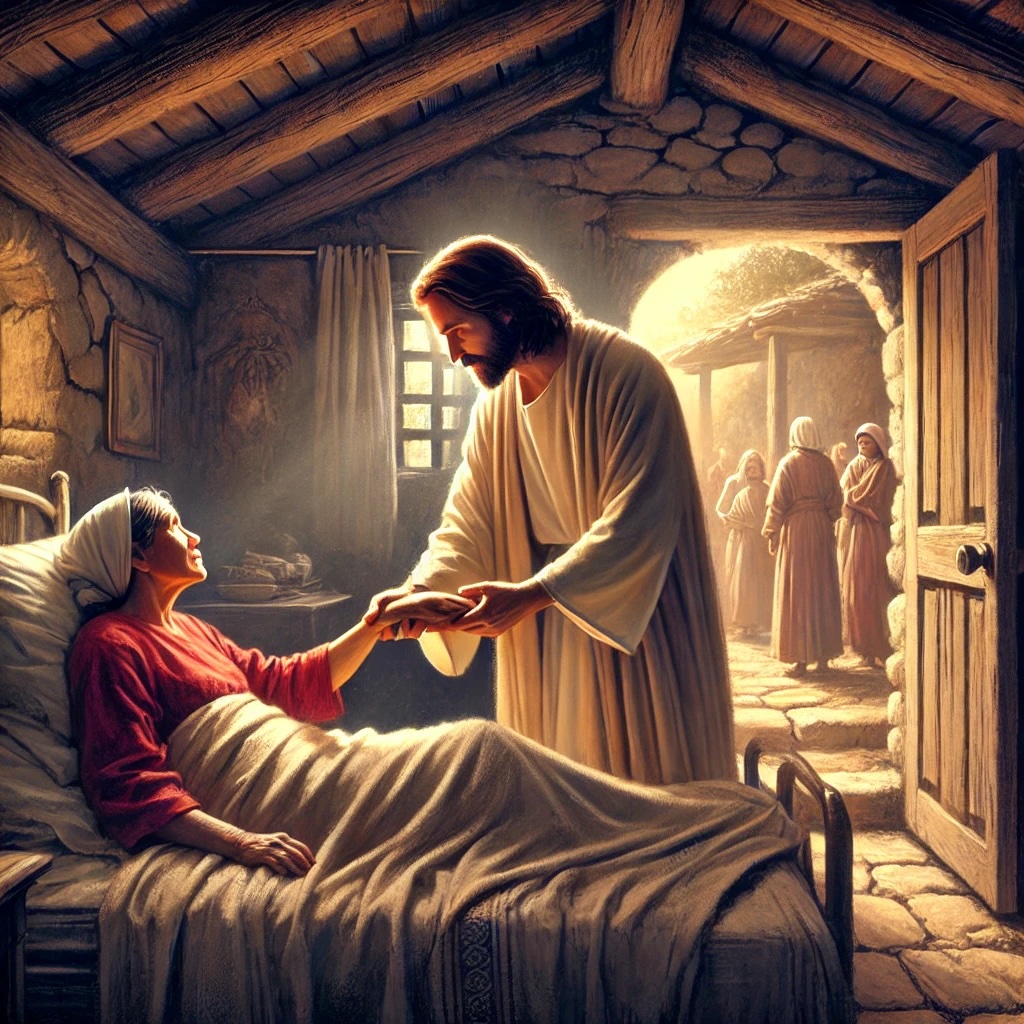
    Jesus reacts instantly. He does not doubt her worthiness for healing. He does not wait. He does not make a spectacle out of the situation. He merely stretches out His hand, raises her up, and the fever subsides.

    There is something really human about this moment. No grandiose gestures. There will be no bombastic proclamations. Just a hand extended, a compassionate touch, a simple restoration.

    And how did she respond? She begins serving them.
    This is more than just a duty; it represents complete healing. She is not only recuperating; she is completely healed, with strength to act and energy to serve. Jesus doesn’t merely cure her fever; He brings her back to life.

    Healing Beyond the Household

    However, this is merely the beginning at Simon’s house. As soon as the Sabbath concludes, the entire village rushes to the door, bringing their sick, suffering, and possessed.

    “That evening around sundown, they brought to him everyone who was ill or plagued by demons. And the entire city was gathering at the entrance. And he healed numerous people suffering from various ailments and threw out many devils.”

    The entryway becomes a point of transition. What began as a simple act of healing in a home turns into a deluge of need at Jesus’ feet. The entire city is now at the door, seeking restoration, relief, and hope.

    Jesus greets them all.

    He doesn’t turn them away. He is not tired of their cries. He touches, heals, and delivers. His authority is not confined to words spoken in a synagogue. It is not limited to private miracles performed in a home. It extends to anybody who comes to Him.

    Authority over sickness and oppression.

    Mark creates a distinction. Jesus cures the sick and expels devils.
    Physical suffering exists, as does spiritual persecution. Both are real. Both are hefty loads. Jesus has authority over them all.

    He not only teaches about the kingdom, but also represents its strength.
    Everywhere He goes, darkness retreats. Sickness is undone. Oppression is silenced. God’s kingdom is more than simply a distant hope; it is already present in the earth. But, despite this exhibition of might, there remains a quiet sweetness. There is no indication that Jesus heals to prove anything. There is no performance or spectacle. Only kindness.

    Healing: A Sign of the Kingdom

    Throughout Jesus’ mission, healing is more than just a return to health. It is an indication of something more.
    The prophets said that God would heal His people: “Then the eyes of the blind shall be opened, and the ears of the deaf unstopped; the lame man shall leap like a deer, and the tongue of the mute sing for joy.” (Isaiah 35:5–6)
    Jesus is fulfilling this promise. Every healing is a glimpse of the kingdom, a proof that God is repairing what was broken, reversing what was lost, and making everything new.

    Nevertheless, He does not allow the devils to speak.
    “He would not permit the demons to speak, because they knew him.”
    Why? Because Jesus’ purpose extends beyond simply performing miracles. He isn’t just a healer or exorcist. His power is real, but His identity has to be revealed in God’s time and way.
    The people see His marvels. But do they really comprehend who He is?

    What Does This Mean for Us?

    This text is not only about the past; it also applies to our current existence.
    Jesus meets us wherever we are. He is present in both sacred and mundane settings. He does not only carry out miracles on great platforms; He also works in the quiet moments, personal hardships, and locations that no one else sees.

    Healing is more than just alleviating misery; it is also about restoration. Simon’s mother-in-law is not only healed; she is restored to life, vigor, and purpose. True healing is about becoming entire, reclaiming our true selves.

    The door is still open. The entire village came at Simon’s door to seek healing. We are still at that barrier today. The invitation stays. Jesus still greets people who come, extends His hand, and mends what is broken.

    Will we come to Him? Will we bring to Him what is weighing us down? Will we believe that His touch can still make everything new?

    The door is open.

    The Healer is nearby.

    Will you come forward?

  • The Gospel of Mark – 07

    The Gospel of Mark – 07

    Jesus enters Capernaum, a fishing town on the northern shore of the Sea of Galilee, and immediately steps into the synagogue on the Sabbath. The people gathered there are used to hearing the Torah taught by scribes, religious experts who interpret the Scriptures. But today, something is different.

    Mark tells us:

    “And they went into Capernaum, and immediately on the Sabbath he entered the synagogue and was teaching. And they were astonished at his teaching, for he taught them as one who had authority, and not as the scribes.”

    From the very first words He speaks, Jesus commands attention. His teaching is unlike anything the people have heard before. It is not filled with rabbinic citations, not a careful balancing act between different interpretations of the law. His words carry weight. They carry authority.

    The Greek word ἐξουσία (exousia) is used here for “authority.” It means more than just power; it implies the right to rule, the ability to act decisively and with divine backing. Jesus does not simply teach about God—He speaks as if He is speaking for God Himself.

    This is not just a teacher. This is something entirely different.

    And before the people can fully grasp what they are witnessing, something unexpected happens.

    A Disruption in the Synagogue

    “And immediately there was in their synagogue a man with an unclean spirit. And he cried out, ‘What have you to do with us, Jesus of Nazareth? Have you come to destroy us? I know who you are—the Holy One of God.’”

    The moment Jesus begins teaching, darkness pushes back.

    A man possessed by an unclean spirit suddenly speaks, his voice cutting through the astonished silence of the synagogue. The people may not yet fully understand who Jesus is, but the spiritual realm does.

    “What have you to do with us, Jesus of Nazareth? Have you come to destroy us?”

    There is fear in the demon’s words. It knows that Jesus is not just another teacher, not just another prophet. It calls Him by name—“the Holy One of God.”

    This is the first direct confrontation between Jesus and the forces of evil in Mark’s Gospel, and it reveals an essential truth: the presence of Jesus is a direct threat to the kingdom of darkness.

    Wherever Jesus goes, light pushes into the shadows. The forces of evil do not act indifferently toward Him. They react, they resist, they tremble.

    Authority Over the Spiritual Realm

    Jesus does not engage in conversation with the demon. He does not ask its name, does not perform a long ritual. He does not appeal to a higher power—because He is the higher power.

    “But Jesus rebuked him, saying, ‘Be silent, and come out of him!’ And the unclean spirit, convulsing him and crying out with a loud voice, came out of him.”

    There is no struggle. No back-and-forth. No contest.

    With a single command, Jesus silences the spirit and drives it out.

    The word “rebuke” (ἐπετίμησεν, epetimēsen) is significant. This is the same word used later when Jesus rebukes the storm on the Sea of Galilee, commanding it to be still (Mark 4:39). The same authority that subdues the chaos of nature is now being exercised over the chaos within a person’s soul.

    Jesus speaks, and the forces of darkness obey immediately.

    This is power beyond human comprehension. And the people witnessing it know it.

    Amazement and a New Kind of Authority

    “And they were all amazed, so that they questioned among themselves, saying, ‘What is this? A new teaching with authority! He commands even the unclean spirits, and they obey him.’ And at once his fame spread everywhere throughout all the surrounding region of Galilee.”

    The crowd had been astonished by His teaching before the exorcism, but now they are completely overwhelmed.

    The scribes spoke about spiritual matters, but they had no power over them. They could explain what God had done in the past, but they could not act with God’s authority in the present.

    Jesus, however, teaches and acts with the same power. His words are not just theories or interpretations—they change reality.

    The people do not simply say, What a great miracle! Instead, they recognize that this miracle and His teaching go together. His authority over the spiritual world confirms the truth of His words.

    And His fame spreads instantly. The news is out: there is a man in Galilee who speaks like no other, who commands like no other, who carries authority like no other.

    What This Means for Us

    The authority of Jesus is not just something to admire—it is something that calls for a response.

    When Jesus speaks, things change. Darkness cannot remain where He is present. He does not tolerate oppression, does not allow deception, does not negotiate with evil. He simply commands it to leave.

    If Jesus has authority over the forces of darkness, then what does that mean for our own fears, struggles, and battles?

    It means that His power is still active today. It means that no force of darkness has the final say over our lives. It means that when He speaks, things must shift.

    And just like the people in the synagogue, we are faced with a question:

    “What is this?”

    Who is this Jesus who speaks, and reality bends to His voice?

    Who is this teacher whose words do not just inform, but transform?

    Who is this man whose presence disturbs the forces of evil, whose very existence threatens the dominion of darkness?

    Mark gives us the answer before the story even unfolds:

    He is the Son of God.

    The question now is—will we recognize His authority, not just in theory, but in our own lives?

    Because the same Jesus who walked into the synagogue in Capernaum walks into the spaces of our hearts today.

    And He still speaks.

    Are we listening?

  • Lent 2025 School of Prayer

    Day 7: Using the Psalms to guide your prayers

    “My soul pants for you, my God, just as the deer pants for streams of water.” — Psalm 42:1

    With its unvarnished and honest pleas that convey joy, sadness, trust, fear, praise, and repentance, the Psalms are frequently referred to be the Bible’s prayer book. The Psalms provide us with phrases to present to God when we are at a loss for words. They serve as a reminder that prayer is about coming as we are, not about saying the correct things.

    In every stage of life, David, the poet of several Psalms, gave his all to God. He cried in times of sorrow (Psalm 13:1-2), asked for pardon in times of failure (Psalm 51:1-2), and gave thanks in times of triumph (Psalm 18:1-3). Whatever he had to deal with, he prayed about it all to God.

    Pick a Psalm that speaks to you today; it could be one of trust, lament, or gratitude. Take your time reading it and use it as a private prayer. Allow the words of Scripture to lead you to a closer relationship with God.

    Thought: Which Psalm resonates with you right now? In what ways might the Psalms enhance your Lent prayer life? Think about committing a verse to memory so you can pray it all day long.

    Fasting and Giving: Give your time to someone in need. Call a lonely friend or visit someone.

    Here is an organized list of Psalms by Topic to guide your prayers:

    ✨ Praise (Worshiping God’s greatness and majesty)

    • Psalm 8 – The glory of God in creation
    • Psalm 19 – The heavens declare the glory of God
    • Psalm 29 – The power of God’s voice
    • Psalm 47 – God reigns over all the earth
    • Psalm 103 – Bless the Lord, O my soul
    • Psalm 150 – Let everything that has breath praise the Lord

    💔 Lament (Crying out to God in pain or distress)

    • Psalm 13 – How long, O Lord?
    • Psalm 22 – My God, my God, why have You forsaken me?
    • Psalm 42 – Why are you downcast, O my soul?
    • Psalm 77 – I cried out to God for help
    • Psalm 88 – A cry from deep suffering
    • Psalm 130 – Out of the depths I cry to You, Lord

    🙏 Gratitude (Thanksgiving for God’s blessings)

    • Psalm 9 – I will give thanks to You, Lord
    • Psalm 23 – The Lord is my Shepherd
    • Psalm 30 – You turned my mourning into dancing
    • Psalm 34 – Taste and see that the Lord is good
    • Psalm 92 – It is good to give thanks to the Lord
    • Psalm 136 – His love endures forever

    🛡️ Trust (Confidence in God’s guidance and protection)

    • Psalm 16 – You will not abandon me
    • Psalm 27 – The Lord is my light and my salvation
    • Psalm 46 – God is our refuge and strength
    • Psalm 56 – When I am afraid, I will trust in You
    • Psalm 91 – He who dwells in the shelter of the Most High
    • Psalm 121 – My help comes from the Lord

    🌑 Absence of God (Feeling distant from God)

    • Psalm 10 – Why, O Lord, do You stand far off?
    • Psalm 42 – As the deer pants for streams of water
    • Psalm 43 – Why have You rejected me?
    • Psalm 63 – My soul thirsts for You
    • Psalm 77 – Has His love vanished forever?
    • Psalm 89 – Where is Your faithfulness, O Lord?

  • 06 Mark 1:16-20 The Call To Follow

    Jesus does not build His kingdom alone.

    From the very beginning of His ministry, He calls others to walk with Him, to learn from Him, to become part of something greater than themselves. His mission is not just about proclaiming truth—it is about forming a community, a people who will embody His message long after He is gone.

    Mark tells us the story simply:

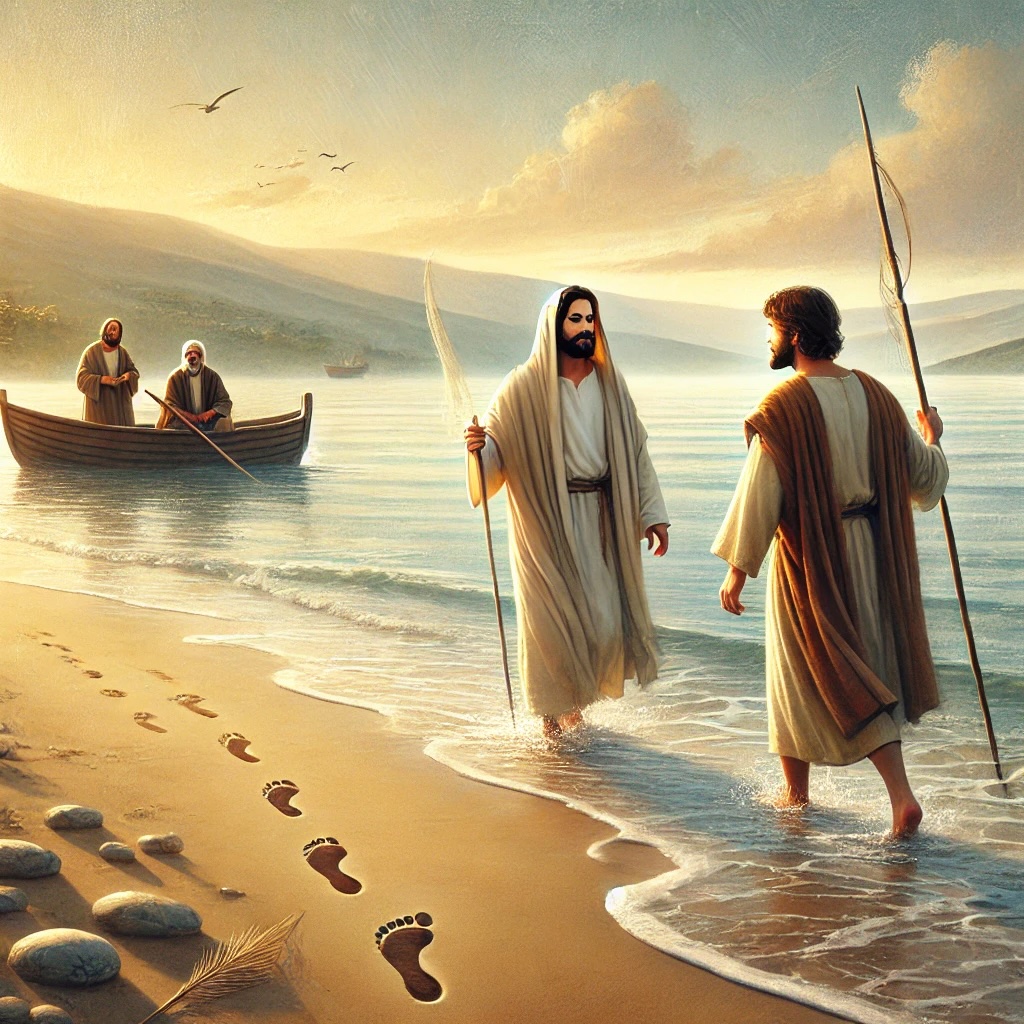
    “Passing alongside the Sea of Galilee, he saw Simon and Andrew, the brother of Simon, casting a net into the sea, for they were fishermen. And Jesus said to them, ‘Follow me, and I will make you fishers of men.’ And immediately they left their nets and followed him. And going on a little farther, he saw James the son of Zebedee and John his brother, who were in their boat mending the nets. And immediately he called them, and they left their father Zebedee in the boat with the hired servants and followed him.”

    There is something disruptive about this moment. These men are not idle. They are not searching for a teacher. They are fishermen, doing what they have always done, tending to the daily work of survival. And yet, when Jesus calls, they drop everything.

    A Call That Interrupts

    Jesus does not wait for Simon, Andrew, James, and John to come to Him. He goes to them. He meets them in their ordinary lives, in the midst of their routines. They are casting nets, mending gear, preparing for another day of work—until Jesus steps in and everything changes.

    We often imagine that life-changing moments come with preparation, with time to consider, with warning signs leading up to them. But in Mark’s Gospel, the call of Jesus is sudden, urgent, and immediate. There is no space for hesitation.

    And yet, there is something about Jesus that compels them to follow. He offers no roadmap, no security, no certainty about what will come next. All He says is, “Follow me.” And they go.

    Perhaps that is how real transformation works. It comes not when we are ready, but when we are willing. It does not always come with full understanding, but with an openness to step forward even when we do not know what the future holds.

    Leaving Behind the Nets

    What Simon, Andrew, James, and John do next is astonishing.

    “Immediately they left their nets and followed him.”

    Their nets were not just tools; they represented security, identity, livelihood. To leave them behind was to step into the unknown, to release the only life they had ever known.

    James and John leave behind not just nets, but their father. Their departure is not just a career shift; it is a radical severing of ties, a complete reordering of priorities.

    Jesus’ call is not a casual invitation—it demands a response that costs something. To follow Jesus means to let go, to release what is comfortable, to step away from what is familiar.

    And yet, they do not hesitate. Why? Because what Jesus offers is greater than what they leave behind.

    Fishers of Men: A New Purpose

    Jesus does not just tell them to follow Him—He redefines their identity.

    “Follow me, and I will make you fishers of men.”

    He does not say, Follow me, and you will be my students. He does not say, Follow me, and you will find deeper spiritual peace. Instead, He speaks in their language, through their experience.

    They were fishermen. This was what they knew—casting nets, waiting, gathering the catch. And now, Jesus takes that same skill, that same patience, that same endurance, and transforms it into something eternal.

    “I will make you fishers of men.”

    Their skills are not erased; they are redeemed for a greater purpose. They will still cast nets, but now for hearts and souls. They will still wait, but now with the patience of those who bring good news. They will still gather, but now into a kingdom that will never fade.

    God does not call us to abandon who we are—He transforms what we already know into something new. The gifts, talents, and experiences we have do not disappear when we follow Jesus. They are redirected, reshaped, repurposed for something greater than we ever imagined.

    The Cost of Following

    It is tempting to read this passage and admire the disciples’ immediate response without considering what it cost them.

    Simon, Andrew, James, and John did not just leave behind nets—they left behind their old way of defining themselves. Their work, their families, their sense of place in the world—all of it changed the moment they said yes.

    Following Jesus is never about adding Him to an already full life. It is about redefining life around Him.

    And yet, even in the leaving, there is gain.

    What they lost in security, they gained in purpose.
    What they gave up in familiarity, they received in calling.
    What they left behind in certainty, they stepped into in faith.

    Jesus does not call people to comfort. He calls them to Himself. And that is always worth whatever we must leave behind.

    The Call Today: Will You Follow?

    This story is not just about Simon, Andrew, James, and John. It is about every one of us.

    Jesus is still walking along the shores of our lives, still stepping into our ordinary routines, still speaking those two simple words:

    “Follow me.”

    The question is, will we?

    What nets are we holding onto that keep us from stepping forward? What security are we afraid to leave behind? What is Jesus calling us to step into, even when we feel unprepared?

    Following Jesus is not about having all the answers. It is about taking the first step.

    And like those first disciples, when we leave behind our old lives, we are stepping into something far greater than we ever imagined.

    The call has not changed.

    The invitation is still open.

    Will you follow?


    Leave a comment

  • 05. Mark 1:14-15 The Time is Now


    Jesus does not start His work in a peaceful time. God doesn’t start His work when things are stable in politics or religion. Instead, He makes His formal announcement after John the Baptist is picked up. The person who made the way possible is now in jail, and the system that Jesus is about to face has shut them up.


    Mark simply says, “After John was arrested, Jesus went into Galilee and preached the gospel of God. He said, ‘The time is over, and the kingdom of God is near. Turn away from your sins and believe the gospel.’”

    These words make you feel rushed. Things are moving. Jesus doesn’t think twice. His message isn’t careful. That’s not what he does to make it more comfortable. So, He goes ahead with His task and tells them something very important: “The time is fulfilled.”
    “The kingdom of God is at hand.”
    “Repent and believe in the gospel.”

    These words aren’t just from the past. They’re still living. People are still welcome to accept them.


    This is the right time: Being in the Kairos Moment

    Jesus doesn’t just mean that history has reached a certain point when He says, “The time is fulfilled.” The Greek word for “time” in this case is kairos, which is not the same as chronos, which means “clock.” Kairos is a turning point, a divine call, or a chance to do something.


    Jesus is telling people that something has changed. Now the wait is over. The long-awaited moment that the prophets spoke about has finally come. It’s not just another part of history; this is the turning point.

    How often do we wait for the ideal time to make a change, move forward, or start something new? When things are just right, when we feel ready, or when we are better ready, we tell ourselves that we will start. But kairos time doesn’t wait for us to be ready; it tells us to act right now.
    Right now is always a kairos moment. No matter what, God is always calling us to start over. The call to change is not something that might happen in the future; it is already here.

    The coming of God’s kingdom: Not an idea but a reality


    One of the most confusing ideas in Christianity is “the kingdom of God,” which is at the heart of what Jesus taught. When we hear the word “kingdom,” we might think of a country’s government, its land, or its people. But the kingdom of God is not a government on earth; it is God’s rule coming into the world.


    ἂγγβκεν (ēngiken, meaning “is at hand”) is a perfect tense word in Greek. This means that the kingdom has already come and is still there. Says Jesus, “The reign of God is not just coming; it is already here, taking shape right in front of you.”


    But if the kingdom has already come, then why is the world still broken? This is what the “already and not yet” means. The kingdom began with Jesus, but it will not be fully finished until the end of time. There it is, but it is still happening. Real, but still waiting to be fulfilled.


    And we are asked to live in this space between—to know that God’s rule is already here even as we long for it to be fully realized.

    We don’t just sit back and wait for the kingdom to come. Jesus’ words make us want to respond. We step into the kingdom, live into it, and become it. It is not a question of whether or not God’s reign has started; it has. The question is whether we will see it and take part in it.


    Don’t repent, but believe: a call to change

    Jesus doesn’t just say that the kingdom has come; He tells people to “repent and believe in the gospel.”


    No, the word “repent” (μετανoεῖτε) does not mean to feel bad or sorry. To change one’s mind is to go in a different direction or see things in a different way. It’s a call to realign, or change the way you live so that it fits with God’s plan.


    And believe (πιστεύετε, pisteuete) is more than just agreeing with something. It means to fully lean on the truth of the gospel, to believe it, and to make a promise.


    Jesus wants people to do more than just believe that the kingdom is close. He wants them to live as if it were true.
    Believing and repenting are not two different things; they are two sides of the same coin. It means to turn away from an old way of living and to think it means to start a new life. Jesus’ call isn’t just for small changes; it’s for a whole new way of living.

    Living in the Kingdom as It Really Is

    How should we live as if the kingdom were already here?
    What does it mean to choose to see the world through the lens of God’s rule instead of fear, lack, or power? It means choosing a life where love is more important than power, where humility is more important than pride, and where service is more important than being in charge.

    It means being aware that every moment has the power to change things.

    Now is that kairos.

    Jesus’ words were important back then, and they are important now. The time has passed. The kingdom is almost here. You can turn away from your sins and have faith today, not tomorrow.

    So the question is: Will we wait any longer, or will we seize the moment? Will we see that God’s kingdom is moving among us, or will we keep living as if nothing has changed?

    You are welcome to join. Now is the time.

    Now is the time.


    Leave a comment

  • 02. Prepare the way (Mark 1:2-4)

    It is not comfortable to be in the wilderness. It is empty, crude, and fraught with doubt. John the Baptist, however, emerges in the desert and cries forth a message that has endured throughout history: Prepare the way of the Lord. His voice does not emanate from the center of religious authority or the corridors of power. Rather, he invites individuals to enter a moment of transformation by standing where few would dare to live.

    John makes it clear that repentance and renewal are necessary. He makes no promises of immediate reform or an easy path forward. Instead, John exhorts people to plunge into the waters of baptism. He urges them to immerse themselves in the Jordan. They should let go of things that no longer serve them. His baptism is a symbolic act of readiness. It is a prelude to something bigger, which they do not yet completely comprehend. It is not merely a physical act of cleaning.

    According to the Gospel of Mark, John wore camel’s hair, a garment that is symbolic of the prophet Elijah, who was to arrive before the Lord’s great and awful day. His existence marks a watershed in history. Something new is emerging as the old fades. But letting go is necessary before embracing the new. People travel to him for this reason from all around Jerusalem and Judea. The wilderness, the discomfort of introspection, and the prospect of rejuvenation all appeal to them.


    John doesn’t talk about himself. One who is stronger than I, whose sandals’ strap I am not worthy of untying, follows me. He is aware that his position is only transitory and that his job is to make room for someone else. He is remarkably humble. John is happy to remain in the background during a period when religious leaders were vying for attention and authority, pointing to the one who will be baptized with the Holy Spirit rather than water.

    The necessity of preparing for change before it can truly take hold is a common theme in this passage. No change occurs in a vacuum. We must face our past and look to the future, just as the people in John’s day did. Without having to put forth the effort to create space for it, it is simple to yearn for something new. We wish for rejuvenation but oppose the purification. We desire a new beginning, but not the wilderness that frequently accompanies it.

    Μετάνοια (metanoia), the Greek term for repentance, is more than just feeling sad for past transgressions. It signifies a reorientation of one’s entire being, a complete shift of mind and heart. This is an active turning, a conscious decision to take a different course, rather than merely an emotional reaction. Repentance is realigning—realizing what is broken and allowing it to be fixed—rather than wallowing in guilt.

    Therefore, the wilderness is more than just a location on a map. It is a soul-related condition. It is where we go when we are lost, when life deprives us of our illusions, and when we have to face the truth. It is in the unnerving grandeur of the unknown, rather than the comfort of the known, that transformation starts. Nevertheless, Mark informs us that the people voluntarily support John. They look for him because they must, not because the wilderness is simple.

    Maybe this is where we are right now, on the brink of something new, knowing that something has to change but not knowing how to start. We can still hear John’s voice saying, “Set the path.” However, how do we get ready? How can repentance manifest itself in our daily lives?

    The necessity of letting go


    For some, it might be about letting go of burdens that have been held for too long. These include regrets, past injuries, or lingering anxieties. For others, it can entail identifying the habits that have prevented them from moving forward. They need to realize what needs to be addressed. Openness, not perfection, is the hallmark of true preparation. It’s about creating room for the future, even if we don’t fully comprehend it yet.

    Repentance is a reorientation of one’s entire being, a complete shift of mind and heart


    John informs the people that Jesus is close by, but they must purify their hearts before they can accept him. This is an internal metamorphosis rather than an outward ceremony. The impending one will immerse people in God’s own presence by baptizing them with the Holy Spirit. However, we must first leave the old in order to immerse ourselves in the new. We are unable to hold onto both simultaneously.

    John would probably say the same thing if he spoke to us now. They would interrupt the din of everyday existence, urging us to stop, look around, and become ready. He would tell us that we must accept what we are leaving behind before we can fully welcome what lies ahead. He would welcome us into the woods as a place of enlightenment and rejuvenation rather than as a place of punishment.

    The outdoors is sacred yet uncomfortable. Distractions disappear there, all that is untrue is eliminated, and the reality of who we are and who we are becoming becomes apparent. In order to be ready to accept the greater when he arrives, we must first prepare our hearts and straighten the road.

    Thus, the question still stands: What needs to be resolved in your life before you may proceed? What needs to be let go, admitted, or given up for regeneration to begin? Just like in John’s day, the invitation is now available. The call is still the same. Clear the path.

    Are you going to advance?