Bible verses: “So this is how you should pray: ‘Our Father in heaven, honor your name.’” — Matthew 6:9
Jesus showed His disciples how to pray by giving them what we now call the Lord’s Prayer. It’s a guide for how we should talk to God. The very first words, “Our Father,” show something very special: prayer is not just talking to a faraway god; it’s a conversation with a loving Father who knows us very well.
Prayer links us to each other
Jesus invites us into a connection based on trust, love, and safety by calling God “Father.” It’s important to remember that we are part of a bigger spiritual family because he doesn’t say “My Father,” but “Our Father.” Prayer not only links us to God, but it also links us to each other as Christians.
The next line, “hallowed be Your name,” tells us that prayer should start with praise and adoration. We acknowledge that God is holy, powerful, and good before we make our prayers. Worship changes the tone of our thoughts by making us think about how great God is instead of how great we are.
Thought: Do you talk to God like a loving father when you pray? How can you worship Him before you pray, focused on who He is instead of what you need?
Fasting & Giving: Give thanks to someone who has influenced your faith. Send a message or write a letter.
From the very beginning of His ministry, He calls others to walk with Him, to learn from Him, to become part of something greater than themselves. His mission is not just about proclaiming truth—it is about forming a community, a people who will embody His message long after He is gone.
Mark tells us the story simply:
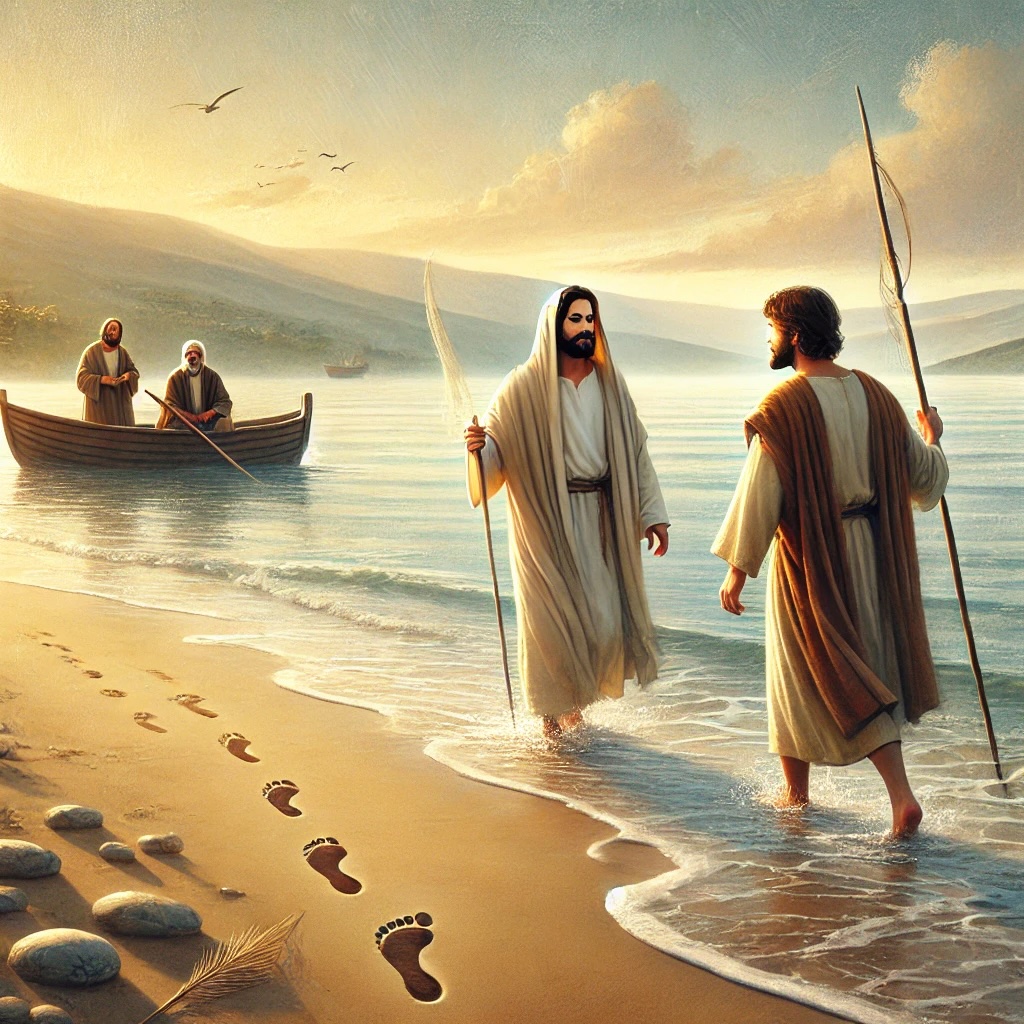
“Passing alongside the Sea of Galilee, he saw Simon and Andrew, the brother of Simon, casting a net into the sea, for they were fishermen. And Jesus said to them, ‘Follow me, and I will make you fishers of men.’ And immediately they left their nets and followed him. And going on a little farther, he saw James the son of Zebedee and John his brother, who were in their boat mending the nets. And immediately he called them, and they left their father Zebedee in the boat with the hired servants and followed him.”
There is something disruptive about this moment. These men are not idle. They are not searching for a teacher. They are fishermen, doing what they have always done, tending to the daily work of survival. And yet, when Jesus calls, they drop everything.
A Call That Interrupts
Jesus does not wait for Simon, Andrew, James, and John to come to Him. He goes to them. He meets them in their ordinary lives, in the midst of their routines. They are casting nets, mending gear, preparing for another day of work—until Jesus steps in and everything changes.
We often imagine that life-changing moments come with preparation, with time to consider, with warning signs leading up to them. But in Mark’s Gospel, the call of Jesus is sudden, urgent, and immediate. There is no space for hesitation.
And yet, there is something about Jesus that compels them to follow. He offers no roadmap, no security, no certainty about what will come next. All He says is, “Follow me.” And they go.
Perhaps that is how real transformation works. It comes not when we are ready, but when we are willing. It does not always come with full understanding, but with an openness to step forward even when we do not know what the future holds.
Leaving Behind the Nets
What Simon, Andrew, James, and John do next is astonishing.
“Immediately they left their nets and followed him.”
Their nets were not just tools; they represented security, identity, livelihood. To leave them behind was to step into the unknown, to release the only life they had ever known.
James and John leave behind not just nets, but their father. Their departure is not just a career shift; it is a radical severing of ties, a complete reordering of priorities.
Jesus’ call is not a casual invitation—it demands a response that costs something. To follow Jesus means to let go, to release what is comfortable, to step away from what is familiar.
And yet, they do not hesitate. Why? Because what Jesus offers is greater than what they leave behind.
Fishers of Men: A New Purpose
Jesus does not just tell them to follow Him—He redefines their identity.
“Follow me, and I will make you fishers of men.”
He does not say, Follow me, and you will be my students. He does not say, Follow me, and you will find deeper spiritual peace. Instead, He speaks in their language, through their experience.
They were fishermen. This was what they knew—casting nets, waiting, gathering the catch. And now, Jesus takes that same skill, that same patience, that same endurance, and transforms it into something eternal.
“I will make you fishers of men.”
Their skills are not erased; they are redeemed for a greater purpose. They will still cast nets, but now for hearts and souls. They will still wait, but now with the patience of those who bring good news. They will still gather, but now into a kingdom that will never fade.
God does not call us to abandon who we are—He transforms what we already know into something new. The gifts, talents, and experiences we have do not disappear when we follow Jesus. They are redirected, reshaped, repurposed for something greater than we ever imagined.
The Cost of Following
It is tempting to read this passage and admire the disciples’ immediate response without considering what it cost them.
Simon, Andrew, James, and John did not just leave behind nets—they left behind their old way of defining themselves. Their work, their families, their sense of place in the world—all of it changed the moment they said yes.
Following Jesus is never about adding Him to an already full life. It is about redefining life around Him.
And yet, even in the leaving, there is gain.
What they lost in security, they gained in purpose. What they gave up in familiarity, they received in calling. What they left behind in certainty, they stepped into in faith.
Jesus does not call people to comfort. He calls them to Himself. And that is always worth whatever we must leave behind.
The Call Today: Will You Follow?
This story is not just about Simon, Andrew, James, and John. It is about every one of us.
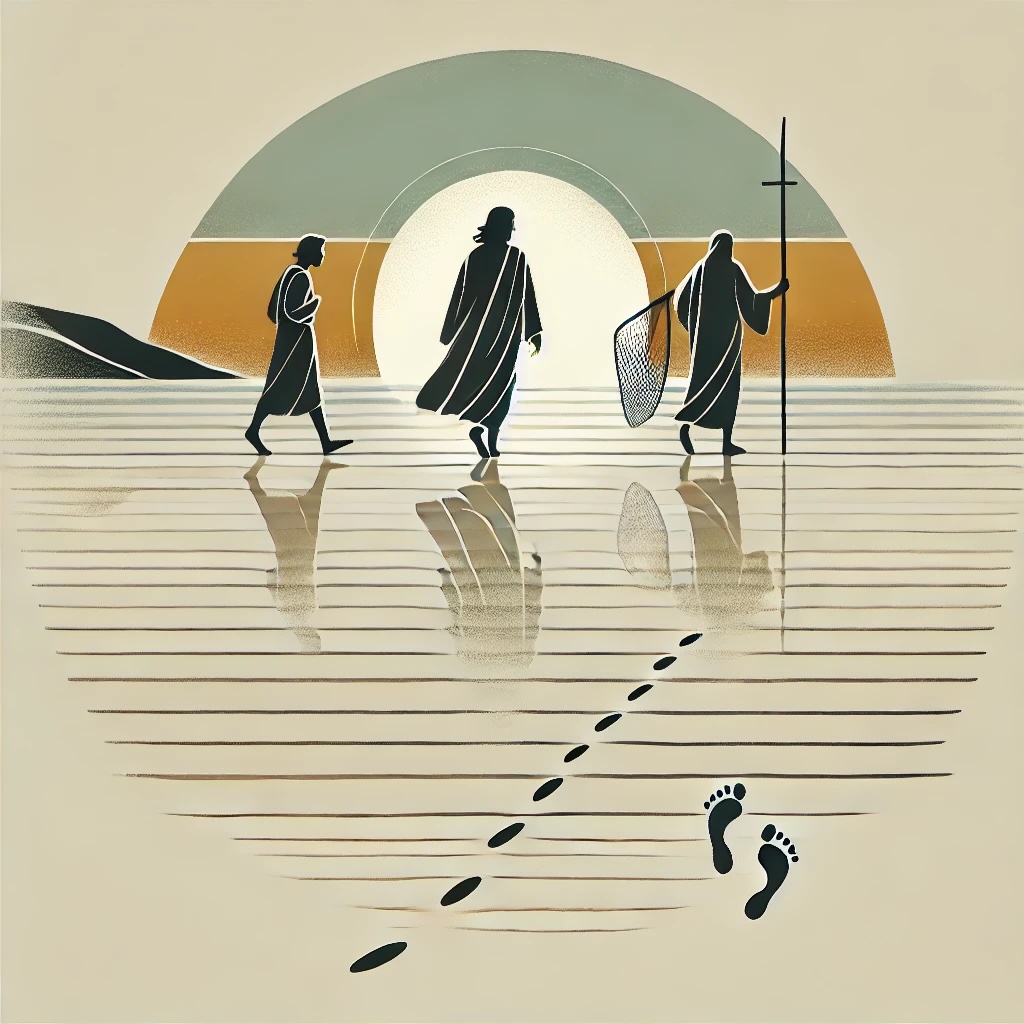
Jesus is still walking along the shores of our lives, still stepping into our ordinary routines, still speaking those two simple words:
“Follow me.”
The question is, will we?
What nets are we holding onto that keep us from stepping forward? What security are we afraid to leave behind? What is Jesus calling us to step into, even when we feel unprepared?
Following Jesus is not about having all the answers. It is about taking the first step.
And like those first disciples, when we leave behind our old lives, we are stepping into something far greater than we ever imagined.
“Speak, Lord, for your servant is listening,” — 1 Samuel 3:10
Prayer is a dialogue. We must learn to listen as much as we speak.
When you pray, you don’t just talk to God; you also listen. We treat prayer too much like a one-way discussion, telling God what we want and need without stopping to hear what He has to say. But real prayer is a conversation. God talks to us in many ways, such as through the Bible, the small things that happen in our lives, and even the things that happen to us.
When young Samuel heard God’s voice in the night, he responded with an open heart and a listening spirit: “Speak, Lord, for your servant is listening.” A young Samuel with an open heart and a willing spirit.
This is how we should pray—not just saying what we want to say to God, but also waiting in silence to hear what He has to say.
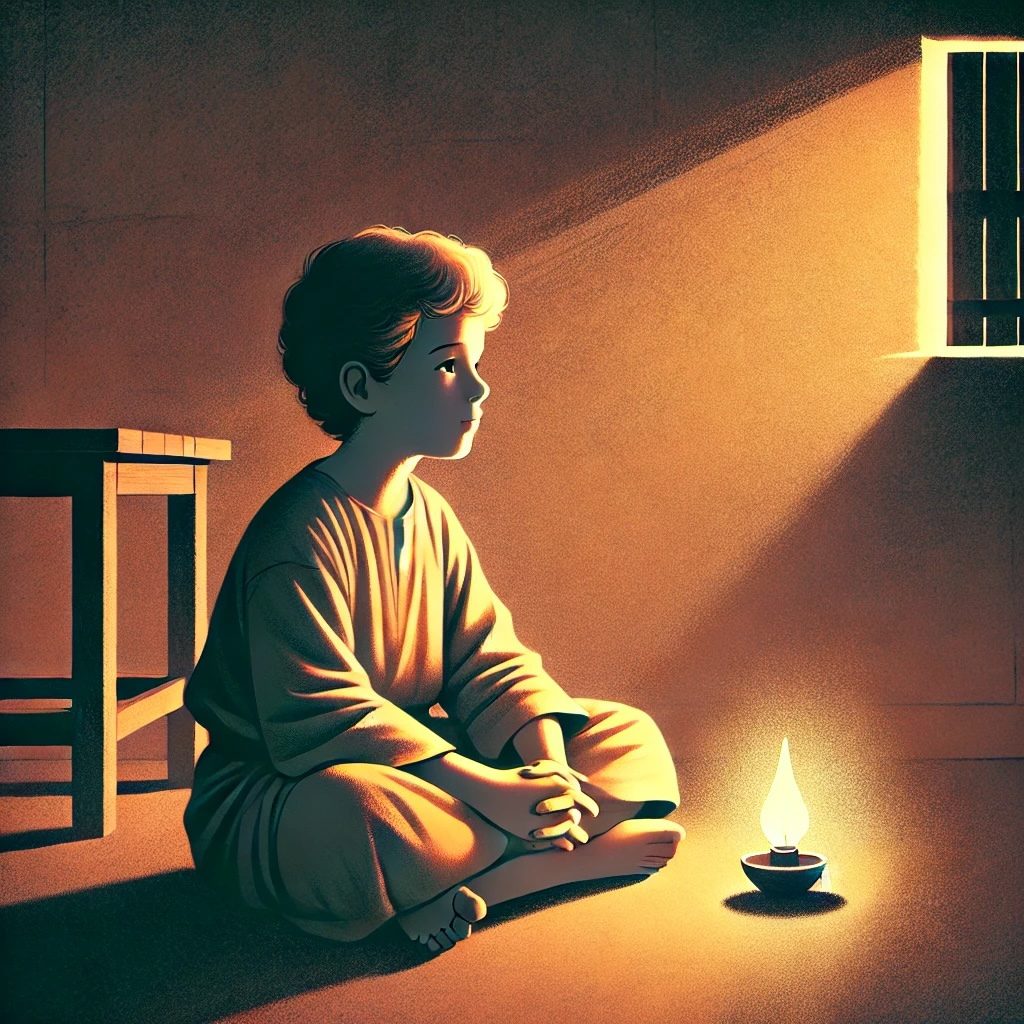
Today, take some time to pray in silence. Don’t say too many words to fill up the room. Say, “Lord, I am here. Speak to me. ” while sitting still. Believe that God loves talking to people who come to Him with an open heart.
Thought: When you pray, do you take the time to listen, or do you mostly talk? What can you do today to make room for God’s voice?
Fast from background noise. Create moments of silence to listen to God
Bible verse: “Ask whatever you want, and it will be done for you, as long as you remain in me and my words remain in you.” — John 15:7
Prayer isn’t just asking for things; it’s also about getting to know God better. He tells us to “remain” in Him, to stay in His love like a branch stays attached to a plant. A branch that is cut off dies, but a branch that stays attached grows fruit. The same is true for our mental lives. We become emotionally dry and cut off from the source of life when we don’t pray.
God wants more from us than just prayers now and then. He wants a friendship that lasts all the time, one in which we share our joys, sorrows, hopes, and fears every day. Think about a close friendship that gets stronger as you talk more. The same goes for prayer. We can hear God’s words and feel His presence in our daily lives better the more time we spend with Him.
Today, pray not because you have to, but because you want to have a Relationship with a loving Father. During the day, talk to Him in small ways, and let His presence fill your heart.
Thought: How can you turn prayer into a living, ongoing connection with God instead of something you do once in a while?
Action: Fast from negative self-talk. Speak words of gratitude instead.
“But when you pray, go to your room, shut the door, and talk to your Father who is outside the room.” Then your Father, who knows everything that happens behind closed doors, will reward you. — Matthew 6:6
Lent is a time to deepen our relationship with God
As we begin this trip through Lent, Jesus calls us to pray more deeply. Prayer isn’t just a show or a bunch of empty words; it’s a holy meeting with God that invites us to get close. Jesus tells us to go somewhere alone, get away from things that might distract us, and let the Father fully see our thoughts.
Prayer is at the heart of Lent, which is a time to start over. We can hear God’s words, feel His love, and align our hearts with His will when we pray. We often have trouble praying because we feel far away or don’t know what to say.
But God doesn’t want perfect words; He wants an honest heart. Take a break from the noise today. Get away from everything, even if it’s just for a short time, and be with God. This is the start of a time of mindful Lent. May your heart become a place where He lives.
Thought: How can you make room in your daily life for God?
Action: Fast from unnecessary phone use. Spend the time in prayer.
“The happiness of your life depends upon the quality of your thoughts.” — Marcus Aurelius
Being happy isn’t something that just happens to us; we work at it every day. The way we think is at the heart of our health. Alexander the Great, a Roman emperor and Stoic philosopher, says that our thoughts create our world. When we learn to think positive, powerful thoughts, we build a world of hope inside ourselves that keeps us going no matter what life throws at us.
So how do we get into this frame of mind? How can we train our minds to think in a way that makes us happy and strong?
Know that your mind has power Our brains are always working to make sense of the things going on around us. There are two ways to look at the same situation: with hope or with dread. Being optimistic means realizing that we can choose which point of view to use.
When things go wrong, instead of asking yourself “Why is this happening to me? “, ask yourself “What can I learn from this?” How can I get bigger? With this easy shift in perspective, problems become chances.
Fight against negative thoughts It is easy for negative thoughts to sneak in and take root. They whisper questions, make our fears bigger, and drain our energy. Thoughts don’t have to be true, just because they come to you.
Start to doubt those thoughts:
Does this thought help me or hurt me? Could you look at this another way? What would I say to a friend who felt this way? When we fight negativity, we weaken its hold and make room for positivity to take over.
Show gratitude every day Focusing on the good things in our lives is one of the easiest and most powerful ways to feel hopeful. Being grateful changes our focus from what we don’t have to what we do have, from lack to wealth.
Try this: Write down three things you’re thankful for every morning and every night. They don’t have to be big; they can just be happy times, people, or events. Over time, this habit changes the way your brain works so that you automatically see the good in things.
Surround yourself with good things The people and places we spend time with affect how we think. Spend time with people who make you feel good, who push you to grow, and who tell you of the good things in life. Read books, listen to music, and watch shows that make you feel good instead of ones that make you feel bad.
Being optimistic isn’t just something you have to do; it thrives in a positive and encouraging atmosphere.
Enjoy the present moment When you worry, you tend to think about the past or be afraid of the future. But happiness and hope are here and now. Focusing on the present moment helps us feel less stressed and find joy in small, everyday things.
Practicing prayer, mindfulness, meditation, or even just taking deep breaths can help us stay in the present and enjoy life as it happens.
Your Feelings, Your Joy Marcus Aurelius knew that what makes us happy is not what happens to us, but what things we choose to think. We can feel deeply and permanently optimistic by recognizing that we have control over our thoughts, fighting negativity, showing gratitude, surrounding ourselves with positive people, and living in the moment.
Even though things aren’t always great in the world, your thoughts and state of mind can be a strong and happy place. And when you feed your optimism, happiness comes easily.
Pick the right ideas, and you’ll see your life change.
Jesus does not start His work in a peaceful time. God doesn’t start His work when things are stable in politics or religion. Instead, He makes His formal announcement after John the Baptist is picked up. The person who made the way possible is now in jail, and the system that Jesus is about to face has shut them up.
Mark simply says, “After John was arrested, Jesus went into Galilee and preached the gospel of God. He said, ‘The time is over, and the kingdom of God is near. Turn away from your sins and believe the gospel.’”
These words make you feel rushed. Things are moving. Jesus doesn’t think twice. His message isn’t careful. That’s not what he does to make it more comfortable. So, He goes ahead with His task and tells them something very important: “The time is fulfilled.” “The kingdom of God is at hand.” “Repent and believe in the gospel.”
These words aren’t just from the past. They’re still living. People are still welcome to accept them.
This is the right time: Being in the Kairos Moment
Jesus doesn’t just mean that history has reached a certain point when He says, “The time is fulfilled.” The Greek word for “time” in this case is kairos, which is not the same as chronos, which means “clock.” Kairos is a turning point, a divine call, or a chance to do something.
Jesus is telling people that something has changed. Now the wait is over. The long-awaited moment that the prophets spoke about has finally come. It’s not just another part of history; this is the turning point.
How often do we wait for the ideal time to make a change, move forward, or start something new? When things are just right, when we feel ready, or when we are better ready, we tell ourselves that we will start. But kairos time doesn’t wait for us to be ready; it tells us to act right now. Right now is always a kairos moment. No matter what, God is always calling us to start over. The call to change is not something that might happen in the future; it is already here.
The coming of God’s kingdom: Not an idea but a reality
One of the most confusing ideas in Christianity is “the kingdom of God,” which is at the heart of what Jesus taught. When we hear the word “kingdom,” we might think of a country’s government, its land, or its people. But the kingdom of God is not a government on earth; it is God’s rule coming into the world.
ἂγγβκεν (ēngiken, meaning “is at hand”) is a perfect tense word in Greek. This means that the kingdom has already come and is still there. Says Jesus, “The reign of God is not just coming; it is already here, taking shape right in front of you.”
But if the kingdom has already come, then why is the world still broken? This is what the “already and not yet” means. The kingdom began with Jesus, but it will not be fully finished until the end of time. There it is, but it is still happening. Real, but still waiting to be fulfilled.
And we are asked to live in this space between—to know that God’s rule is already here even as we long for it to be fully realized.
We don’t just sit back and wait for the kingdom to come. Jesus’ words make us want to respond. We step into the kingdom, live into it, and become it. It is not a question of whether or not God’s reign has started; it has. The question is whether we will see it and take part in it.
Don’t repent, but believe: a call to change
Jesus doesn’t just say that the kingdom has come; He tells people to “repent and believe in the gospel.”
No, the word “repent” (μετανoεῖτε) does not mean to feel bad or sorry. To change one’s mind is to go in a different direction or see things in a different way. It’s a call to realign, or change the way you live so that it fits with God’s plan.
And believe (πιστεύετε, pisteuete) is more than just agreeing with something. It means to fully lean on the truth of the gospel, to believe it, and to make a promise.
Jesus wants people to do more than just believe that the kingdom is close. He wants them to live as if it were true. Believing and repenting are not two different things; they are two sides of the same coin. It means to turn away from an old way of living and to think it means to start a new life. Jesus’ call isn’t just for small changes; it’s for a whole new way of living.
Living in the Kingdom as It Really Is
How should we live as if the kingdom were already here? What does it mean to choose to see the world through the lens of God’s rule instead of fear, lack, or power? It means choosing a life where love is more important than power, where humility is more important than pride, and where service is more important than being in charge.
It means being aware that every moment has the power to change things.
Now is that kairos.
Jesus’ words were important back then, and they are important now. The time has passed. The kingdom is almost here. You can turn away from your sins and have faith today, not tomorrow.
So the question is: Will we wait any longer, or will we seize the moment? Will we see that God’s kingdom is moving among us, or will we keep living as if nothing has changed?
Life tests us. We move ahead bearing weight, following aspirations, and conquering obstacles. Sometimes our legs feel weighty, and weariness sets in. Is it possible for us to move still another step? But as poet Rumi so masterfully reminds us:
Your legs will grow weak and fatigued. Then comes a time of feeling the wings you have developed lifting.”
Perseverance has magic like this. We find a secret strength within us just when we believe we have nothing to offer. Our weight was shaping us, building us, getting us ready for flight, not only a struggle.
The moment you get up from sleep Many times, we are blind to the development within us. We pay close attention to the fight, the tiredness, and the will required to stay on. Every difficulty we encounter, meanwhile, is gently building wings of resilience, knowledge, and bravery. And then we experience them—least expected, of course. We know we are soaring rather than merely strolling.
Once-overwhelming challenges become the wind beneath us, raising us above our wildest expectations. What used to bring us down now offers us power.
Count on the process. Thus, if you’re fatigued, keep going. Every step, every difficulty, every struggle is helping you to shape something more. The moment will arrive when you transcend all, stronger, freer, and more competent than you could have imagined.
You should have flown, not just walked. Continue on. Already waiting for you to feel them are your wings.
Overcoming Obstacles: How Every Wall Can Be Repurposed as a Floor You are always evolving as you go through life. We aim high, challenge ourselves, and rejoice when we succeed. But after we accomplish the seemingly impossible, what comes next? Aldous Huxley’s adage, “Every ceiling, when reached, becomes a floor, upon which one walks…” serves as a constant reminder that achievement is not the end, but rather the beginning of much bigger potential. Climbing to the Peak: The Delusion of Limits When we initially focus on a goal, it could seem like an insurmountable mountain to climb. Whether it’s climbing the corporate ladder, becoming an expert in a new field, or triumphing over a personal obstacle, we all face periods of uncertainty. How likely is it that I will be able to pull this off? Looking high and unapproachable, the ceiling looms over the room.
However, we continue to go forward by being persistent, learning, and resilient. The previously insurmountable becomes attainable. Despite setbacks, we persevere and succeed in the end. When we overcome what seems like an insurmountable obstacle, an extraordinary transformation occurs: it transforms into our new normal.
Embracing Change: The Influence of Viewpoint
When we accomplish something we never imagined possible, our outlook changes. Things that were difficult before are now easy. Once terrifying, things like starting a new career, taking on a leadership role, or going through a big life change are now commonplace.
Expansion is beautiful in this way. What challenged us before lays the groundwork for what is to come. What lies beneath us are the accomplishments, challenges, and lessons of our history. Knowing that this ceiling, too, will be beneath our feet in due time, we can look up and aim for the next one.
Indulging in the Ongoing Ascent Never settle for less than what Huxley has to offer. Life is not about getting to the top and then staying there; it’s about going downhill from there. Aiming higher, dreaming greater, and becoming even better versions of ourselves should be our driving desire with each new level of achievement.
Therefore, accept and even celebrate your present “ceiling” as it is. Go confidently in its direction; when you stand upon it, you will see heights you never knew were conceivable. Simply said, there are no real boundaries; rather, there are endless possibilities.
Continue to ascend. Continue to grow. There is always more to learn.
Who makes your story what it is? It’s nice to think that we’re in charge of our own lives. We have the right to think, choose, and believe what we want. Is that really true, though? Or, like Dorian Gray, are we shaped by the sounds around us? Some are good, some are bad, but they all leave their mark on the person we become.
We learn more about how Dorian changes in Chapter 3 of The Picture of Dorian Gray. There is still something different about the young, attractive guy who has Basil Hallward’s attention. He is now influenced by Lord Henry Wotton, a man whose words are more important than his deeds and whose philosophy pulls people in instead of pushing them.
A bad idea is what starts Dorian’s path toward self-indulgence, not a single bad deed. A whisper. Just a thought. You should be certain that pleasure is the most important thing, that morality is a lie, and that your sole responsibility is to yourself.
This is the real start of his fall.
How Chapter 3 Shows Us Our Own Lives Through the Power of Words
At the beginning of the chapter, Lord Henry goes to see his uncle, Lord Fermor, to find out more about Dorian’s family history. Here, we learn about Dorian’s sad family history. His mother, Margaret Devereux, was incredibly beautiful, but she broke society norms by falling in love with a lowly soldier. This love wasn’t meant to last. It seems likely that her father, Lord Kelso, set up the fight between the soldier and the officer to kill him. Soon after, Margaret died of a broken heart, leaving Dorian alone.
Dorian grew up in a home without love and was cared for by his cold and mean grandpa. He never got the kind of loving guidance that helps a young person become strong, self-aware, and moral. Instead, he acquired wealth, beauty, and, perhaps most dangerously, a need for admiration and respect.
Lord Henry steps into this emotional hole.
At a fancy lunch later in the chapter, Henry gives one of his most alluring talks yet. He tells them that pain has no purpose, that morals is made up, and that they should only live their lives for fun. People around him can hear him without having to shout. His words, which are full of charm and wit, stick in their minds. Dorian pays close attention because he is already fascinated by Henry’s ideas. The changes are already happening.
But let’s take a break from the book for a while. Let’s look at ourselves through the lens of the story.
Who has made you who you are?
Chance vs. Fate: How Much of Us Is Really Ours?
Dorian wasn’t bad from the start. He wasn’t meant to be vain or careless. He was weak, though. He was a perfect subject for Henry’s theory because he didn’t have any family love, he loved beauty, and he wanted to fit in.
Are we really that different?
Remember things from your own life. Could it have been a teacher, a friend, or a mentor? Did their words ever change the way you saw the world?
Someone may have given you ideas, encouraged you to be the best version of yourself, and opened your eyes to new opportunities.
Or maybe, like Lord Henry, someone put a seed in you that made you want to hurt yourself. Perhaps it was a friend who encouraged you to disregard your intuition, a relationship that forced you to compromise your principles in order to blend in, or an idea that led you to believe that happiness solely hinged on receiving approval from others.
Dorian picks to pay attention to Lord Henry. He chooses to yield to Lord Henry’s influence.
The main difference between fiction and real life, though, is that we can see these effects before they make us who we are.
Self-Reflection Activity: Who Has Had an Impact on You?
Take some time to think. Write in a journal or just think about these questions as you sit down:
Who in your life has had the most impact on what you believe?
Did they have a good or bad effect? Or both?
Did they make you more like who you are, or did they try to change you into someone you weren’t supposed to be?
If you think about it now, do you think their words helped you, or did they make you feel less like yourself?
Now, picture for a second that Dorian had never met Lord Henry. Imagine that instead of Henry’s alluring ideas, Dorian had a mentor who showed him the value of being kind, strong, and having self-worth above all else.
Would he have picked the same things?
Would he have changed into the same person?
And if we think about our own lives, what would have happened if we had listened to different voices?
Finding the Right Balance Between Self-Discovery and Outside Influence
Lord Henry tells Dorian that the most important task is to be oneself. We shouldn’t let fear or moral rules stop us from going after what we want. This way of thinking seems freeing at first glance—who wouldn’t want to live their life without regrets?
However, going after joy without thinking about it can be dangerous.
Yes, we owe it to ourselves to find out who we are, get what we want, and decide what makes us happy. But are we really free if we do things without thinking about how they will affect us, other people, or our future? Or are we just trying to avoid taking responsibility?
Balance is key to growing as a person. It’s about being happy while also being aware of what we’re changing into. In contrast to Dorian, we can think about the opinions we let into our lives. We can pick to listen to people who will help us grow instead of people who will hurt us.
Last Words: Are We Free or Are We Dorian?
Dorian is still on the verge of changing at this point in the book. He hasn’t done any really bad things yet. He’s not yet the kind of man who will hide his picture out of fear. But things have started to change.
He is no longer just himself; what Lord Henry said has become a part of him.
How about you?
You should be living your own truth. Are you still hearing someone else’s voice?
We are not stuck in a book like Dorian is. We don’t have to let what other people say about us define us. We can choose to forget things that don’t help us. We are empowered to change our own stories.
Finally, as you leave this part of the book and this time for thought, ask yourself:
What do you want to be? Whose voice are you going to let shape that answer?














 Vita Dinamica: Dynamic Life
Leave a comment