“He then took the bread, blessed it, and broke it. He then gave it to them and said, ‘This is my body, given for you; do this in memory of me.‘” — Luke 22:19
The Eucharist is the Church’s most important prayer. When we receive the Body and Blood of Christ, we remember what He did for us. We also become one with Him. The Eucharist feeds our hearts and makes our faith stronger. It also reminds us that prayer is more than just saying words; it’s about being one with God.
Jesus thanked God before he broke the bread. This shows us that when we pray, we should always be thankful and aware of God’s presence. The Eucharist reminds us that God is not far away; He is close, present, and giving us everything He has.
Take some time to pray today before and after you receive the Eucharist. Let it be a moment of deep connection. Thank Jesus for what He did. Ask Him to change your heart. There is a spiritual communion you can do today if you can’t accept the Eucharist. With love and respect, invite Jesus into your heart.
Reflection: How does accepting the Eucharist make your prayer life stronger? How can you get your heart ready for this big mystery in a more deliberate way? Take some time to be thankful that Christ is present in the Eucharist.
Fasting & Giving: Give in a hidden way. Do something kind without seeking recognition.
“My grace is enough for you, because my power is made perfect in weakness.” — 2 Corinthians 12:9
We all have to go through hard times, and praying can be hard during those times. But the Bible tells us that God’s kindness is strongest when we are weak. God did not take away Paul’s pain when he asked for his “thorn in the flesh” to be taken away. Instead, He told him, “My grace is sufficient for you.”
Jesus prayed while He was in pain. Even though He was in a lot of pain in Gethsemane, He gave in to the Father’s will. His pain became the way for us to be saved. In times of pain, prayer is not about getting rid of the pain; it’s about finding God’s power in it.
If you have something that’s bothering you today, talk to God about it. He may not take away your pain right away, but He promises to give you kindness, peace, and strength to get through it. Prayer doesn’t always make things better right away, but it does change us.
Reflection: What kind of pain or trouble do you need to bring to God today? How can you believe that His kindness will keep you going? Allow yourself to give up your pain and know that He is with you.
Fasting & Giving: Fast from laziness. Do an act of service for someone without being asked.
“Because we are surrounded by such a great cloud of witnesses, let us throw off everything that stands in our way… and run with perseverance the race that has been set out for us.” –Hebrews 12:1
We don’t pray by ourselves. We belong to a big spiritual family made up of Christians from all over the world and time. The saints, or religious people who have died before us, are part of this great group of witnesses. They cheer us on and pray for us.
The Bible shows us how important intercessory prayer is and how believers should help each other. For a long time, the Church has revered the saints. They are not worshiped, but seen as models of holiness and prayer partners. We can ask friends to pray for us. We can also ask people who have walked this path before us to pray for us.
Think about the faith of the saints today. Think about how much they prayed, gave, and trusted God. What can you learn from them? Today, if you feel called, pray with a saint and ask them to help you get closer to Christ.
Thought: Which saint makes you believe in God? How can following their lead make your prayer life stronger? Ask God to help you become more steadfast and holy, like they did.
Fasting & Giving: Give in a hidden way. Do something kind without seeking recognition.
“A righteous person’s prayer is powerful and effective.” – James 5:16
We may love and serve others around us in one of the strongest ways. This is through intercessory prayer, which involves praying for other people. People who stepped up to pray are mentioned throughout Scripture:
Sodom was spared because Abraham stepped in (Genesis 18:23–33).
In Exodus 32:11–14, Moses begged on behalf of Israel.
The Lord continues to pray for us (Hebrews 7:25).
Our hearts are transformed into vessels of God’s love and compassion as we lift up others in prayer. When we pray for the people we hold up, we join Him. We help in His mission to heal. We guide and transform their lives.
Who do you think could use some prayer right now? A companion in peril? Is a loved one having trouble? Is our nation in danger? Spend some time praying—standing firm in your faith before God to ask for their forgiveness.
Reflection: If you would like to pray for someone or something today, write it down. Pray for each one, knowing that your prayers have an impact. What steps can you take to incorporate frequent intercessions into your prayer life?
Fasting & Giving: Fast from self-centered prayers. Pray only for others today.
“And I will do whatever you ask in my name, so that the Father may be glorified in the Son.” — John 14:13
At the conclusion of our prayers, we frequently say, “in the name of Jesus, Our Lord.” But what is the true significance of this? It is not a magic formula. It is an act of faith, authority, and harmony with His will. Jesus invites us to pray in His name.
One thing that happens when we pray in Jesus’ name is that we recognize His authority. It’s not about our own righteousness, but about how Jesus established a way for us to approach God through Him.
Praying in Jesus’ name means we direct our prayers toward His will. We focus on His heart rather than on our own wishes or plans. Jesus assures us. If we pray to Him in His name, He will respond in a way that brings glory to the Father. We have faith in His power.
Say “in Jesus’ name” with purpose when you pray today. Use it as a constant reminder that you are praying in the power and assurance that comes from Christ.
Reflect: Are you seeking to have your prayers answered in a way that will please Jesus? In His name, how can you pray today with more assurance and trust? Just for a moment, put your faith in His strength and pray fearlessly.
Fasting & Giving: Give your service to your church or a local charity.
“Father, I commit my spirit to you,” — Matthew 23:46
Before His crucifixion, these were Jesus’ final remarks. After enduring great betrayal, agony, and suffering, He surrendered himself completely to the Father. It was a pledge to trust, not a cry of failure. Even in His crucifixion, Jesus surrendered His life to God.
When we pray correctly, we rely on God completely, even when we are confused about His will. Just like Jesus did, we are to trust that God is good. We must believe that He is in control of our lives. We should place our anxieties, concerns, and troubles in His hands.
Today, what are you holding onto tightly? How does your heart feel? Are you filled with fear, doubt, or confusion? Just as Jesus prayed, “Father, I give You my life, my struggles, and my future.” Stop fighting and start trusting that everything is in God’s control.
Reflection: what one item can you let go of today? Do you want to follow Jesus’ example? Can you trust Him completely? This is important, even when you have no idea what the future holds. Please offer it up to Him in prayer.
Fasting & Giving:Fast from complaining about small hardships.
“Father, forgive them; they do not know what they are doing,” — Luke 23:34
Jesus prayed for His enemies even when He was going through the worst pain on the cross. He didn’t curse the people who made fun of, tortured, and crucified Him. Instead, He prayed for them and asked the Father to pardon them. This is the best form of prayer that shows grace and love.
It’s not always easy to forgive. It’s normal for us to hold on to pain, anger, or resentment when we are hurt. Our Lord, however, tells us to follow a different path: the path of charity. We can forgive more easily when we pray. It makes our hearts softer by telling us that God has forgiven us too.
Do you need to forgive someone? It could be a deep wound or a small hurt that won’t go away. Today, try to be like Jesus. Say a prayer for them. Let your prayer be the first thing that helps you heal, even if you’re not ready emotionally.
Thought: Do you hold grudges against people? What can you say to God about this today in your prayer? Ask Him to help you let go of your anger, and pray for the people who have hurt you.
Fasting & Giving:Give an act of forgiveness. Release resentment against someone.
“The Rose and the Thorns” – about love and having the guts to listen.
It started with a sprout.
The Little Prince saw it one morning while taking care of his world. A different seed had started to grow. Like everything else unexpected in life, it filled him with wonder. It also made him worry.
He paid close attention.
Things that grow aren’t always safe. He was very aware of this. Baobabs also start out as simple green shoots. They can grow into monsters that crack the earth under their feet if nothing is done to stop them.
So, the Little Prince waited, not sure what to do. He hoped this new life would be a flower, but he was afraid it might really be another baobab.
He wasn’t aware of it yet. He was learning the first love truth. At first, love may come as a surprise. It is full of both hope and danger. It could look like beauty or danger. It looks like both a lot of the time.
When It Blooms
The flower finally got bigger and opened. He could not breathe after seeing what he saw. He had never seen anyone like her before.
A Rose—beautiful, flowing, and uniquely her own. The Little Prince fell deeply and without any doubt in love with her right away.
But he was confused almost right away.
The Rose wasn’t easy. She was haughty, picky, and easily hurt. That’s how she talked. She asked for strange things. She sighed deeply and gave him hints that he didn’t get.
She said there were drafts, but she turned down the glass dome. She wanted to be admired, but she didn’t care. She was pretty and far away, dainty and full of thorns.
The Little Prince said, “The flower is very complicated.”
That’s how he felt: amazed and worn out.
It wasn’t easy for him to love her.
Why the Thorns Were There
The Rose was proud of her thorns. They were her security, she said. They would keep her safe from tigers and other bad things. The Little Prince was confused and didn’t know what to think about this. He thought that her thorns were more of a sign than a tool. Still, she held on to them as if she were nothing without them.
“What good are thorns?” he had asked earlier, in pain.
The Rose wasn’t really trying to scare everyone, though.
Her goal was to keep herself safe.
The thorns were also not tools.
They were walls. How many of us do the same thing? • Use humor instead of being honest how often do we? • Pull away from each other when we want to be close? • Pretend we don’t care because we feel open when we do?
The Rose was scared, but not of the Little Prince. She was scared of how much she needed him. Also, this is a love truth: When people want to connect with others the most, they often guard themselves the most. People often guard themselves most when they desire connection.
Not understood
The Little Prince didn’t get her. He had an open heart, was honest, and wasn’t complex. He was very clear when he loved. He couldn’t hide the fact that he was hurt.
As for how the Rose made her feel, she used a different language. She was complicated and unknown. She hid her need as pride. She covered up her fear with pride. The Little Prince began to wonder if she really cared because she didn’t say “I love you” clearly.
So, he started to pull away, which is something many people do when love gets complicated. His heart, which used to be happy, became heavy with worries.
He said, “One shouldn’t listen to flowers.” “It’s enough just to smell them and look at them.”
He didn’t want to listen anymore because it hurt too much. But this wasn’t knowledge; it was disappointment. That voice belonged to someone who loved deeply but hadn’t learned how to stay when things got tough yet.
We’ve all done this, right?
We fall in love with someone because they are beautiful. But we freeze when we see how complicated their feelings are.
We think that their emotional shields mean they are being rejected. “Maybe I should just admire them from afar,” we tell ourselves. Love is not admiring beauty from afar, though. It is wanting without being linked.
It asks us to listen, even if the words are hard to understand. This is what real, deep love. It tells us to stay, even if the other person hides behind their thorns. It asks us to believe, even if people are scared and hard to reach.
Things He Didn’t Know
In a later part of the story, the Little Prince will realize how wrong he was at this point. “I should have judged her by what she did.” I didn’t know how to love her yet. I was too young.
It’s too late for him to grasp that the Rose had truly loved him all along. However, it was not in the way he believed she would. Care, not judgment, was what she needed. Someone who could see past the thorns to the delicate flower inside was what she needed.
He left his world not because he stopped loving her. He didn’t get that love often speaks in strange ways. We need to learn how to understand it.
What This Tells Us
One of the most emotionally complex parts of The Little Prince is this chapter.
It also shows us a lot about how our own relationships work. Love starts with awe and grows through understanding. People who are hard to love are often the ones who worry that they are not loveable. Emotional complexity is not a flaw; it comes from pain, past experiences, and longing. Listening is more than just hearing words; it means figuring out what someone is trying to say emotionally.
Thoughts: Think about the Roses in your life. • Have you misunderstood someone because they didn’t show love the way you thought they would? • Have you ever left a friendship or connection that was hard for you emotionally? • Have you ever hid your need to be loved behind thorns like pride, snark, or distance? If that’s the case, what would happen if you came back without answers but with kinder ears?
Love is not a problem that needs to be solved. It’s important to hold someone in their inconsistencies. Understand them in their doubts. Listen to them, not just admire them.
The Rose is hard to understand. We’re all the same.
To love someone, though, is not to escape the thorns.
To let the flower open, you have to stay for a while.
Jesus exits the synagogue, where He had just cast out an unclean demon, and enters the home of Simon and Andrew. It is a shift from public to private. It changes from a big display of authority in a hallowed venue to a quiet, intimate setting at home. But His influence does not diminish when He leaves the synagogue. The same authority that hushed the devil now extends into the intimate and mundane—to illness, suffering, and the daily difficulties of human life. Mark informs us:
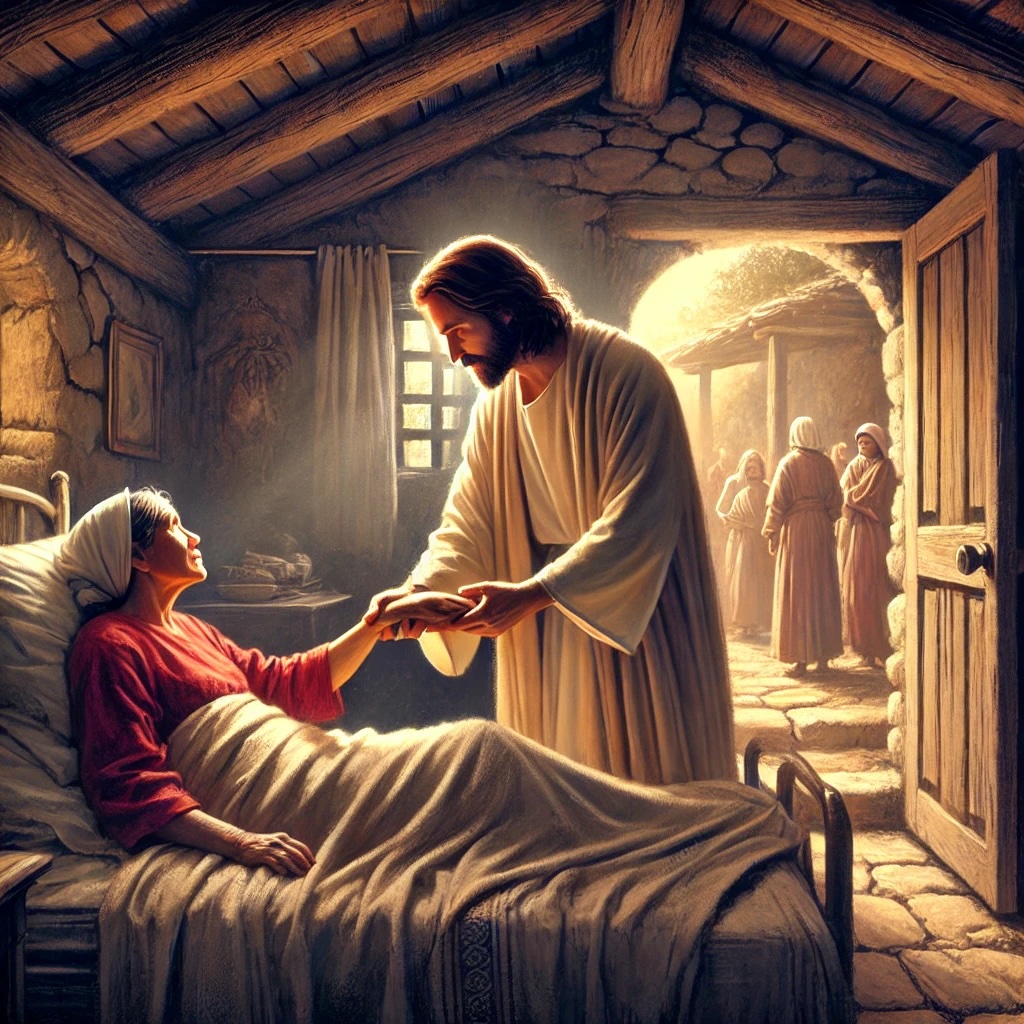
“And he quickly left the synagogue and entered Simon and Andrew’s house, accompanied by James and John. Simon’s mother-in-law was now unwell with a fever, and they promptly informed him of this. And he came and grabbed her by the hand, pulled her up, and the fever subsided, and she began to serve them.”
Healing That is Personal
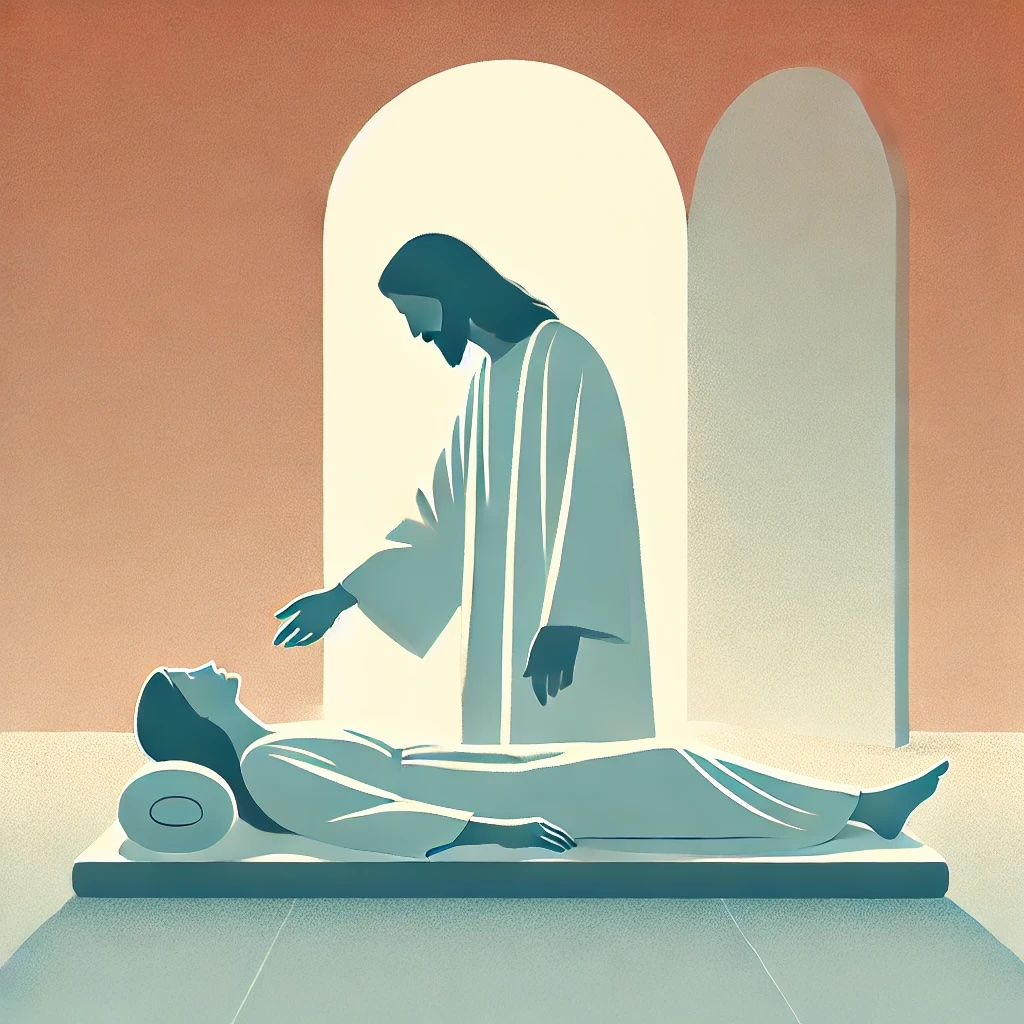
The scenario is simple, but powerful. Simon’s mother-in-law is ill, and they rush to Jesus for help. There is no lengthy explanation or complicated plea, just a simple acknowledgment: she is ill. Jesus reacts instantly. He does not doubt her worthiness for healing. He does not wait. He does not make a spectacle out of the situation. He merely stretches out His hand, raises her up, and the fever subsides.
There is something really human about this moment. No grandiose gestures. There will be no bombastic proclamations. Just a hand extended, a compassionate touch, a simple restoration.
And how did she respond? She begins serving them. This is more than just a duty; it represents complete healing. She is not only recuperating; she is completely healed, with strength to act and energy to serve. Jesus doesn’t merely cure her fever; He brings her back to life.
Healing Beyond the Household
However, this is merely the beginning at Simon’s house. As soon as the Sabbath concludes, the entire village rushes to the door, bringing their sick, suffering, and possessed.
“That evening around sundown, they brought to him everyone who was ill or plagued by demons. And the entire city was gathering at the entrance. And he healed numerous people suffering from various ailments and threw out many devils.”
The entryway becomes a point of transition. What began as a simple act of healing in a home turns into a deluge of need at Jesus’ feet. The entire city is now at the door, seeking restoration, relief, and hope.
Jesus greets them all.
He doesn’t turn them away. He is not tired of their cries. He touches, heals, and delivers. His authority is not confined to words spoken in a synagogue. It is not limited to private miracles performed in a home. It extends to anybody who comes to Him.
Authority over sickness and oppression.
Mark creates a distinction. Jesus cures the sick and expels devils. Physical suffering exists, as does spiritual persecution. Both are real. Both are hefty loads. Jesus has authority over them all.
He not only teaches about the kingdom, but also represents its strength. Everywhere He goes, darkness retreats. Sickness is undone. Oppression is silenced. God’s kingdom is more than simply a distant hope; it is already present in the earth. But, despite this exhibition of might, there remains a quiet sweetness. There is no indication that Jesus heals to prove anything. There is no performance or spectacle. Only kindness.
Healing: A Sign of the Kingdom
Throughout Jesus’ mission, healing is more than just a return to health. It is an indication of something more. The prophets said that God would heal His people: “Then the eyes of the blind shall be opened, and the ears of the deaf unstopped; the lame man shall leap like a deer, and the tongue of the mute sing for joy.” (Isaiah 35:5–6) Jesus is fulfilling this promise. Every healing is a glimpse of the kingdom, a proof that God is repairing what was broken, reversing what was lost, and making everything new.
Nevertheless, He does not allow the devils to speak. “He would not permit the demons to speak, because they knew him.” Why? Because Jesus’ purpose extends beyond simply performing miracles. He isn’t just a healer or exorcist. His power is real, but His identity has to be revealed in God’s time and way. The people see His marvels. But do they really comprehend who He is?
What Does This Mean for Us?
This text is not only about the past; it also applies to our current existence. Jesus meets us wherever we are. He is present in both sacred and mundane settings. He does not only carry out miracles on great platforms; He also works in the quiet moments, personal hardships, and locations that no one else sees.
Healing is more than just alleviating misery; it is also about restoration. Simon’s mother-in-law is not only healed; she is restored to life, vigor, and purpose. True healing is about becoming entire, reclaiming our true selves.
The door is still open. The entire village came at Simon’s door to seek healing. We are still at that barrier today. The invitation stays. Jesus still greets people who come, extends His hand, and mends what is broken.
Will we come to Him? Will we bring to Him what is weighing us down? Will we believe that His touch can still make everything new?
Jesus said: “My prayer is not only for them.” I also pray for those who will believe in me via their word, that they may all be one, Father, as you are in me and I am in you. — John 17:20-21
On the night before His crucifixion, Jesus prayed not just for His followers but for all future Christians, including ourselves. His highest wish was for us to be united as one body, just as He is with the Father.
This demonstrates that unity among believers is at the heart of Jesus’ plea. Too frequently, we let differences—whether in beliefs, backgrounds, or traditions—to divide us. But Jesus invites us to a higher standard: to love, forgive, and remain united in Him. Our togetherness serves as a witness to the world about God’s love.
Today, pray for more unity in your family, church, and among all Christ-followers. If you are divided in your feelings toward someone, ask God for the grace to seek peace and reconciliation. Let us match our prayers with Jesus’ desire: to be one in Him.
Reflection: Are there any relationships in your life that require healing? How can you be a source of unity and love for others around you? Take time today to pray for unity.
Fasting & Giving: Fast from mindless social media scrolling. Read Scripture instead.










 Vita Dinamica: Dynamic Life